The Durham County Proclamation, the Executive Director’s statement, a story from a caregiver, and data
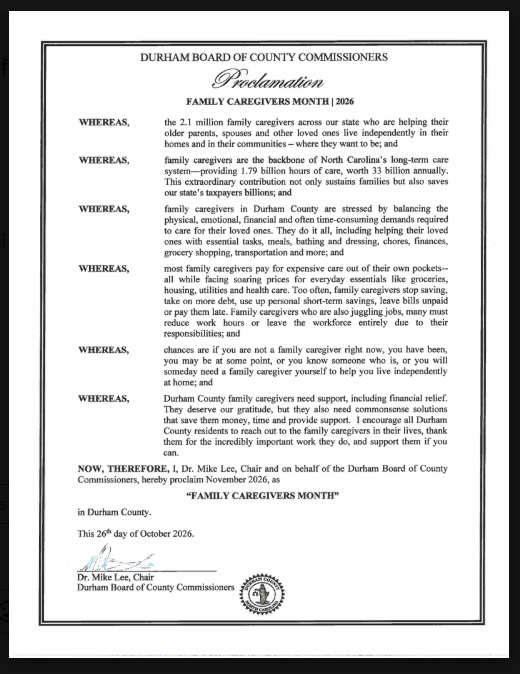
On Monday, October 26th, the Durham Board of County Commissioners recognized November as Family Caregivers Month in Durham County. The purpose of the proclamation is to raise awareness of how caregivers support their loved ones and our local economy. It is also a call for collective action to increase practical ways we can all bolster resources and services for caregivers.
The City of Durham will issue a similar proclamation at its regular business meeting on Monday, November 16th. The meeting starts at 7pm and the proclamation will be at the top of the agenda.
If you want to show your solidarity with caregivers, please join Aging Well Durham at the meeting in-person or virtually on the City’s YouTube channel – https://www.youtube.com/cityofdurhamnc
To see the proclamation as a pdf file, click the thumbnail at the end of this article.
Shelisa Howard-Martinez’ statement to the County Council members and audience:
Thank you to the Durham Board of County Commissioners for recognizing November as Family Caregivers Month in Durham County. I also want to thank the Commissioners for allowing me to speak this evening. My name is Shelisa Howard-Martinez. I am executive director for Aging Well Durham. Aging Well Durham is the backbone group for the Durham Comprehensive Aging Plan. I am also here as a board member of Dementia Inclusive Inc. and a co-chair of the Partnership for a Healthy Durham. I am mentioning these specific affiliations because group is lifting up family caregivers through direct support, data collection and advocacy.
One example, the Partnership for a Healthy Durham held listening sessions with community members last year. The purpose of the sessions is to collect information about what we in Durham County believe should be health priorities. In response to the question, “What are your primary causes of stress?” caring for someone else was the fourth cited reason by community members and parenting or caring for a child was the sixth reason.
Care work is a priority for the Durham Comprehensive Aging Plan. Over the next year, Aging Well Durham and our partners are forming a coalition that will be focused on advocacy and practical ways for how we can better support caregivers.
This year, AARP released a report this year called “Valuing the Invaluable.” One key finding from the report is that in North Carolina, family caregivers provide $33 billion of uncompensated care every year. $33 billion dollars is approximately the same amount for the state’s budget that was signed by Gov. Stein this
July.
Family caregivers are not just good people doing what is expected of them. They are a major economic force. They, we because I am also a family caregiver, are filling gaps for our every sector in Durham County because without care work, no other type of work is possible. We must do better to lift up family
caregivers beyond pats on the back and offering the very unhelpful comment of “I don’t know how you do it.”
I am inviting every member of the Durham County Board of Commissioners to join the Aging Plan’s caregiver coalition because we need your collaboration, your ideas and people power so that Durham County will do better by family caregivers.
Thank you for allowing me to speak.
Shelisa Howard-Martinez
Executive Director, Aging Well Durham
A Caregiver’s Story:
I am a caregiver. I am also Sam Peterson, the communications coordinator for Aging Well Durham. The following is a personal story about when I moved to North Carolina with my friend Peter.
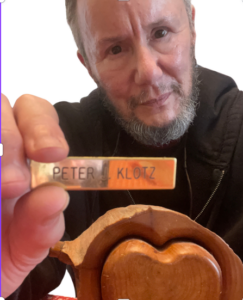
67 year old Peter Klotz had remitting-relapsing multiple sclerosis; he was in pretty rough shape when I moved him to Chapel Hill. We had found a terrific place on ten acres of woods, and the landlord let us retrofit his home with bars and other stabilizers for Peter.
My job was to take care of him, from 7am to 3pm. We got a little bit of money for me to do so through his disability in Texas, where we were moving from. We assumed North Carolina would be better at paying the caregiver (I don’t know why). It wasn’t. I don’t recall what DSS gave us but it was quite small. I worked another, better paying job in the afternoon.
Living and working with Peter was exhausting. He was a dear friend, but he–and his illness–were made extremely challenging by the lack of government support. We were so restricted by our tiny budget, and the few doctors that would see him. We became very snappy with each other because we were so frustrated.
He was also a dear soul, and we cracked each other up all the time. Laughter is a wonderful coping mechanism!
He couldn’t bathe himself, he could use the bathroom, but not IN the bathroom. We set up a “toilet” in his room, next to his bed, where he could, with effort, sit up and use his cane to slide over to the throne. He used a catheter. He had special creams to slather on various parts of his body, which was prone to fungus and bedsores. He could feed himself but not cook, and he was very particular so most of the time I cooked.
I spent a year with Peter, until MS riddled his brain, and he could no longer do the most fundamental things anymore. It was heartbreaking. There was also honestly some relief too, because by that time I was so fatigued from working with him–even for just one year–many times 24 hours a day, as the relief care person wouldn’t show up, or he was having difficulty overnight.
I became insomniac as I was hypervigilant for any sounds he might make, and went through months of sleeping 3-5 hours a night. My body shook even when I was still. I was broke. Finding a state-run long-term facility that would not merely house him in reasonable conditions, but would see him for the unique character he was, was nearly impossible. But that’s another burnout journey for another time!
We stayed in touch and he died about a year later.
Had we had income to support him and ourselves, respite might have been available. I could have dressed him decently; his tee shirts were nearly rags when he moved. I was living in a strange state where I didn’t know many people, and I was socially deprived. I was depressed because he would only ever get worse.
I had agreed to care give for Peter because I loved him, but it’s hard to look back at that time with any sense of joy. The 2025 statistics for caregivers, from Caregiving in the US released by AARP and the National Alliance for Caregiving, revealed a quickly changing caregiving landscape that now includes 63 million Americans, a nearly 50% increase since 2015.
“Family caregivers provide the majority of long-term services and support in the United States, assisting adults with disabilities and complex health needs with daily tasks of living, complex medical and nursing tasks, and coordination of medical and social services—nearly all without pay. Drawing on Caregiving in the US 2025, this report estimates that the 59 million caregivers of adults provided 49.5 billion hours of care in 2024 at an average value of $20.41 per hour. This sums to a total economic value of $1.01 trillion for all adult caregiving in 2024.”
https://www.aarp.org/pri/topics/ltss/family-caregiving/valuing-the-invaluable-2026-update
From AARP:
Demographics: One in every four adults is a caregiver. Of these, 94% care for adults, and one in three is under age 50. Caregivers are increasingly diverse across race, income, and generation. 29% are sandwich generation caregivers, supporting both children and adults.
Intensity and Complexity: Over 40% of caregivers now provide high-intensity care. Many perform complex medical tasks like administering injections or managing equipment, yet only 22% receive training.
Health and Financial Strain: One in five caregivers report poor health; a quarter are taking on debt due to caregiving. Half report negative financial impact due to caregiving, and one in five cannot afford basic needs like food.
Workplace Impact: Seven in ten family caregivers are employed, but many face disruptions and lack access to supportive benefits, especially the 18 million hourly wage workers.
Paid Caregivers: For the first time, the report includes 11 million caregivers who receive some compensation through Medicaid, VA, or other state programs. These caregivers are more likely to be younger, lower-income, and from diverse backgrounds.