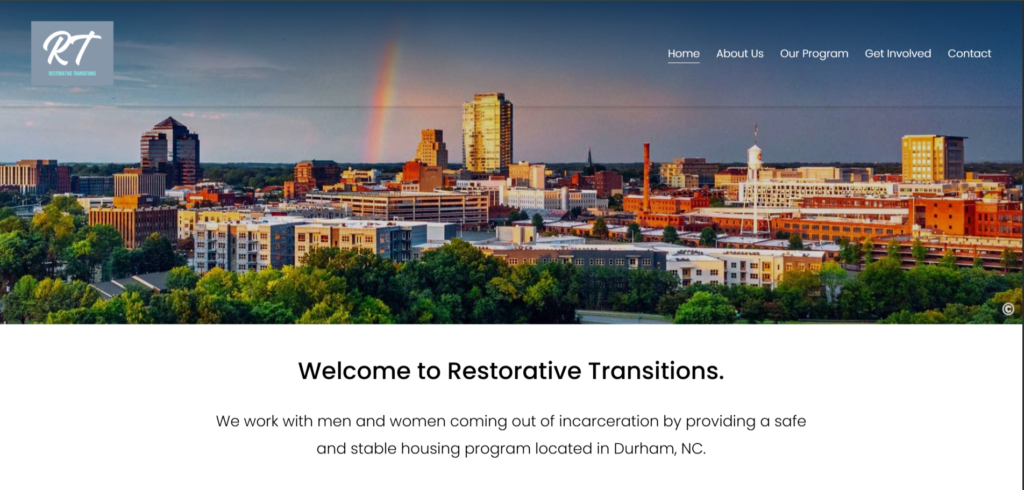
Housing is one of the domains of Durham’s Comprehensive Aging Plan. AWD works with a number of organizations whose mission is to create affordable, safe, community-oriented, inclusive and accessible housing options. AWD spoke with Bobby Harrington, Program Manager of Restorative Transitions–a non-profit organization “dedicated to working with people coming out of incarceration by providing safe and stable housing located in Durham”–to hear how they ensure participants of their program have a stable present and future.
Hi Bobby, can you tell us about Restorative Transitions?
Restorative Transitions is a reentry housing program. We don’t specifically serve the older population, but we’ve noticed–because a lot of guys come home after going 20, 30, even 40 years in prison– that the need is there for housing. Not only is the need there for housing, there’s a need for a caretaker, or healthcare support. They don’t have that. It even gets worse depending upon what their charges are.
Wow. Tell me about how that works, please.
We provide not only just transitional housing, but also case management. We help them connect with mental health care, if needed, and substance use disorder care if needed.
We connect them to financial resources that might help with the program fee (It is $400 per month to live in their residential housing), and give them a three week grace period before starting the program fee. Three weeks goes by very quickly, so we want to connect with resources and get them help in that area, get people helping with employment, helping connect to vocational rehabilitation, if they have some mental health needs.
Also, we want to get them a cell phone, from this organization called Welcome Home Program, with the Durham Local Reentry Council, which is the resource for many women coming home from prison.

Do you call them clients or participants or?
Yes, we are communities, so these are participants.
How do you find people or how do they find you?
Word of mouth.
We came together during COVID coincidentally. Which wis kind of hard, but people heard about the program, connected with case managers, and then word got the prison, and probation and parole. Just word of mouth. For instance one of the individuals coming home: they’ve heard about the program from folks who have been through the program. The person didn’t graduate from the program, but still spoke highly of us to other individuals, “Hey, look, how did they make them do the program?” “It’s a great program.”
I imagine people that are justice-involved (formerly incarcerated) come out of prison and find there’s a real lack of support for them.
Oh, agree, agree. One of the hardest things that we see in life with the elder community, is lack of support upon release, considering their age.
What is the age range of your participants, generally?
45 to 70 years old.
Aging Well Durham is the backbone group for the City and County’s Comprehensive Aging Plan. One of the plan’s strategies is to increase the amount of supportive housing for older adults in Durham. What are some of the challenges unique to your older participants who live in your houses?
One participant, he moved, so we got him in an independent building housing. We think he’s got dementia just based on his actions. He’s disoriented, he’s forgetting people’s names. He still hasn’t had a psychological assessment to get a diagnosis.
Another participant came home with cancer. One guy came home, he’s had an aneurysm before. He had a heart attack. He had a stroke while with us. He’s a fall risk. So just connecting with them. There’s no connection (out in the world). I’ll give you another example: there are individuals who come home on the sex offender registry. You know how broad that registry is? It could be from urinating in public to rape.
The fact of the matter is, these men are 60, 70 years old. How are we going to keep holding them accountable to something? This man has been in for 36 years. Ain’t all gonna fly, even if he wanted to. Where does the grace to mercy come in as far as helping these men; they’re still human, and they still have a need, so we’re going to put them on the streets?
We had a couple guys, they didn’t get connected. I had a guy, it wasn’t even a housing issue. He came home with kidney failure, wasn’t connected to any nephrologist, no type of support, and didn’t want to go see the doctor because it was a 30 minute walk from a nephrologist to the bus stop.
He just chose not to go, because his breathing would be strained walking that kind of long distance to see the kidney doctor. He didn’t even know the severity of his condition. But it’s just the point, that we can do better, even connecting people with Medicaid before they’re released.
They have case managers in prison. They (case managers) get no support. They call me sometimes a week before, a man’s coming home who’s been locked up 18 years.
But now, a week before his release, you find out, you know what? He needs housing. And we can’t find him housing, because a lot of times we’re full because the need is so great. What can we do about anything? A week, that plays on your heartstrings, because you want to find a way, but then you can’t do that.
It just kind of feels defeating sometimes, but you have got to keep fighting.
That just speaks to the need for more agencies dedicated to housing.
We’re a nonprofit. We had six houses, now we have five, because, you know, budgeting, got to pay our salaries, etc. It costs to run the program.
Currently people are holding their purses now, with good reason, because we don’t know the state of our economy and things like that. But it also causes a lot of pain for those who really need that support. It’s all about the dollar, not about the person.
We’ve got to bring it back around.
Keep fighting til I leave this earth!
Do you find that different populations, marginalized communities like Black, Hispanic, LGBTQ, have differing needs than others? How do you attend to that?

Yes, the needs vary. We work with various cultures and various health issues from HIV to asthma. Schizophrenia to mild depression. We meet people where they’re at and outsource according to their need.
I see that Restorative Transitions’ mission is to empower justice-involved individuals through holistic care. Could you say what holistic care looks like?
That comes with case management. We’re meeting people right where they’re at, but everybody’s needs are different. Everybody’s education is different. So being with a person, seeing where they’re at, observing them, because some people think they have knowledge and understanding of a certain area, but that knowledge may not be as expansive as they think.
Meeting them where they’re at, finding out what their needs are, connecting them to, most importantly, their healthcare needs, substance use issues, mental health, or medical. That’s why we have what we call a Faith Team.* They’re volunteers. Their goal is to build community. We aren’t made to do life on our own. We want to be there with you throughout the duration of your life, but the fact of the matter is, the program’s in you. Our goal is to build community around you so once you leave, you’re not on your own.
There’s something about being alone that leaves you vulnerable to the distractions and triggers out here in the community.
Social isolation is a huge issue for the older population. I imagine it’s huge for people that are justice involved as well.
Pandemics!
What are one or two things that you wish people in Durham understood about people who are returning to the community after incarceration? What can or what should we do to support people who are in this situation? What can we do?
A lot of times, people want a stronger, safer, community. We can’t do this alone, you know, the old African proverb: it takes a village. I really believe that if we don’t come together, and support people holistically, we’re going to keep seeing these outcomes that we’re seeing in our community. We’re going to keep seeing recidivism, and we’re going to keep seeing overdoses, and the community fall to the wayside.
What other agencies do you work with?
I work with Alliance Health. They have a program called Transitions to Community Living | NCDHHS (TCL) . They are helping people who have severe mental disabilities transition into more independent housing, like their own apartments, and getting out of adult care homes and assisted living. There was this settlement back in 2012, (that required North Carolina to have 3,000 supported housing slots by 2020. TCL is the result of that settlement). They have to offer people who have severe mental illness independent housing, to transition from a state psychiatric unit to the community.
At one time, they were denying people that. A lot of people said, “Look, I’m baseline now, getting medication management. I’m ready to go back to the community.” “Oh, no, you’re not ready.” The Department of Justice filed a suit, and it went all the way to the Supreme Court and they won. The goal of that settlement was to get people out of a home and get them out of assisted living.
I see it on a much broader scale, and it breaks my heart. I go to visit a client, but then there’s other clients here trying to start the conversations because they don’t have anybody coming to visit. When they’re seeing friendly faces, they’re like, “Hey, hey, come talk to me!”
I’m sure you get your ear talked off by people-hungry people.
Yes, but like I said, I’m only one person. That’s why I said it takes a community. Durham is really set apart from all the other communities. It’s definitely more progressive.
With older clients, what do you do or does anything change with older participants?
The resources change, the engagement might be a lot more supportive, even post graduation. We’ve got a participant right now who’s doing hospice from one of our houses because he has pretty extensive cancer.
His time is limited, and he doesn’t have anywhere to go. His attitude is: this is my family. I think he did 36 years. He’s going to end his time with us. So just being there, and committing to Oak City Health. They do a lot of work for people who are on Medicare. They help older individuals, all the populations, navigate the system, and be their primary health care too. They specifically work with the older population. Oak Street Health, 3729 North Roxboro, Suite B, Durham, NC 27704.
What are one or two things that you wish people in Durham understood about people who are returning to the community?
We all make mistakes. A lot of times, what separates a person who went to prison from a normal working member of society, is opportunity. You give people an opportunity that reduces recidivism. I have had this experience myself. I’ve been to prison six times, not because I was a bad person, but there was a lack of opportunity.
I came home in 2011. it’s just, it’s amazing what support, accountability, and opportunity can do for a person.
It’s uplifting hearing you. You obviously have so much heart for this work.
We’ve got a staff of three. We have three.
I was going to ask you about that. Do you all live on site or you don’t live on site, but you go to these different houses and…?
We’ve created a culture and an atmosphere in the housing. We don’t have to be there. We’ve got cameras hitting the house, we have door codes where you get in. We have a case manager and a program manager. We have a program associate. We have structure around the house, curfew. You can do random drug test, as well.
We connect them with a Faith Team. We connect them with other various resources. So it’s not just us trying to reinvent the wheel. We are just trying to make sure we connect with people who are doing it, and doing it well.
I know it’s part of the program but can you be a non-Christian and participate?
Of course. Yes, we had a fellow who practiced Wicca. He graduated, too. Yes, we got people who are Muslim in the program right now. We don’t force nothing on nobody. Our goal is just to love all people.
To me, love is not feeling so much of an emotion. “Hey, I’m loving you.” It’s based on being patient, being kind. Being forgiven.
It’s an action word.
That’s right. I might not be feeling it emotionally, but I still choose to treat you right, choose to be kind, to be patient.
*The Faith Team comes from an organization named Religious Coalition of a Non Violent Durham.
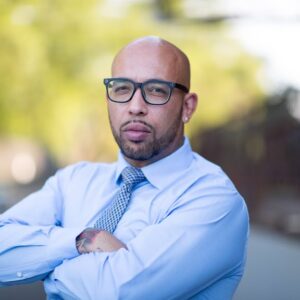
Bobby Harrington is a Raleigh native with lived experience navigating the North Carolina justice system. Since his release in 2011, he has dedicated his life to advancing mental health recovery and promoting social justice for individuals returning from incarceration.
Bobby brings over a decade of experience as a Peer Support Specialist and has served as an Advanced Level Facilitator for Wellness Recovery Action Planning (WRAP) for the past eight years. He is an active member of the North Carolina Certified Peer Support Specialist Workgroup, where he contributes to policy development that strengthens certification standards, training, and accountability for peer support professionals across the state.
Throughout his career, Bobby has served his community in various capacities—as an employee, contractor, volunteer, and advocate. His work includes serving with Alliance Health as an In-Reach and Engagement Specialist in the Transitions to Community Living Program, where he supported individuals with severe mental health diagnoses in transitioning to stable community living. He also contributed to the early development of the UNC FIT Program as a Community Health Worker, helping formerly incarcerated individuals in Wake County access critical healthcare services upon reentry.
In Durham County, Bobby played a key role in the development and management of Restorative Transitions as a Program Manager. In this role, he supported individuals returning from incarceration by connecting them to healthcare, employment opportunities, life skills development, and community-based support systems.