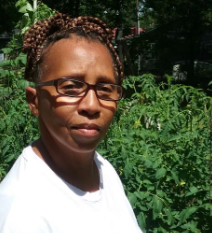
Jacquelyn Blackwell has a long history of community involvement, working to get food to Durhamites through a variety of agencies. She is currently the Executive Director of Feed My Sheep, a food pantry* “that offers Hope, Healing and Hospitality by providing groceries and a hot meal to those who suffer from food insecurity.” She also manages the food pantry at JJ Henderson Housing Center.
Food and nutrition are a crucial domain in the Durham Comprehensive Aging Plan (of which Aging Well Durham is a lead agency). Mrs. Blackwell represents the hardest working of that domain; she seems to be feeding people everywhere at all times, but she made room to chat with Aging Well Durham about her work.
The 2025 Durham Aging Plan includes End Hunger Durham, and Feed my Sheep as lead agencies. I know that you also work with J.J. Henderson and I’m sure that’s probably just the tip of your iceberg.
It is. I do a lot of different things. It actually started with Feed My Sheep. Feed My Sheep has been a pantry since 2004. But they were at a church, and their pastor started saying, like most pastors, that there’s a need in the community, and we want you to set something up. As time evolved with them, Feed My Sheep became their own 501(c)(3) nonprofit.
Then the church merged with another church, and they decided they no longer wanted the food program there. Our pastor at my church challenged us to create two programs, an in-house program and one outreach program. One of my friends, and a member of my church, was riding the bus and he happened to go by the Feed My Sheep’s gate at that time, Feed My Sheep was looking for a new home. So we were like, “We have a whole building, so let’s just make it work.”
Perfect!.
I became the link between the church and Feed My Sheep. It just kind of evolved from there. And I’ve been with them for 13 years.
It sounds very serendipitous. What did that look like?
I started out as the volunteer coordinator for them. I managed all of the community service people, all of the volunteers that were coming in. I created their schedule. Because I was at the church, I had the keys. When their program manager passed away, I took his position. Then they merged two positions together, so that’s how I became the executive director.
What was it that drew you to food as an issue? Was it just by accident?
No, I grew up in Rutherford County. And I remember my mom. We pretty much fed everybody in our little town. Everybody knew us. My mom would cook for people and she would make sure everybody had food. So I guess it’s just kind of ingrained in me to help others.
When I went to North Carolina Central University, being a college student who could cook and lived off campus, I saw how many of my other classmates were saying, “I’m hungry. I have no food. I have no money.” And so I started feeding them. It just followed me.
I taught school.I dealt with children and they were in the same situation. I brought more lunches and snacks for kids and items. I just think it may have been, I guess you would say, part of my calling.
I ended up in End Hunger Durham because the Durham Food and Farm network had its subcommittees, and our vice chair at that time was on this committee. She said, “Jacquelyn,, you go to these meetings and talk to these people, and get the information. I just can’t do it.”
I ended up taking her place on that committee. There were five subgroups at End Hunger Durham and one was a food justice group. When they decided that it wasn’t working out, End Hunger Durham had taken on its own personality. They combined food justice and a health group together. Betsy Crites** named the new group End Hunger Durham.
From there on it was about disparities. Where were the gaps in food and where was the gap in resources? Being able to help people know where the resources were and show them how to navigate those resources was crucial. Our goal was to cut out some of the middle man stuff.
You would have to know what you were talking about when you went and what you had to do to make that process a little bit easier. It’s been challenging and fun. I was curious because the churches were involved in this.
Can you tell us about the overlap of faith and food, just generally, or personally, if you’re willing?
Well, here’s what I’ve noticed. One of the things that we do is, a food pantry operates as a meeting. Churches sponsor them, and it’s a lot. We have good intentions – you’re supposed to feed the hungry, the seniors and the orphans – things like that. But what people don’t realize is that it is work.
So I think your faith and your belief makes you continue. Because if you don’t believe that this is your mission and you don’t believe that this is the work that the Lord has put on your heart and put in your hands, you will not continue. You will faint. It’s hard work. It’s hard work. It’s rewarding, but it’s also hard work. ‘Cause you’re not only dealing with your vision and your mission that the Lord has given you, but you’re also having to deal with volunteers who might be trying to sabotage you. Because they think you are doing something a little bit better than they are.
Personalities.
Yes. You’re not gonna make it.
It seems that you’re looking at the face of poverty and hunger, which is a hard thing to look at.
You just have to know that in the end – it’s gonna be worth it. But when you’re out there and it’s raining on you, and you have trucks to unload and it’s you and one person, you’re trying to figure out how to get at 30,000 pounds of food inside a building…it’s a lot. That is a lot.
I have people who call and say, ”Well, we want to start a food pantry” I’ll say “Okay. What do you want to do? Who’s gonna run it?” You know, I feed them all the questions:
- Who’s going to run it?
- What are you trying to do?
- What are your hours?
- Who’s going to be your faithful workers?
- Who are your volunteers?
And they’re like, “Well, we hadn’t thought about that! “
You know, my pastor said he wanted to do a food pantry, he put me in charge, and I knew nothing.
You had to learn on your feet. Can you tell us what exactly Feed My Sheep does?
Feed My Sheep is basically a food pantry. My right hand person and I had gotten older, so we decided that it was too much for us. We were the largest food pantry in East Durham. We served a thousand families twice a month. When I got involved in End Hunger Durham, we started what we called a “coalition station.” We basically went out to the food pantry, and we said, ”Okay, I know you’re here for food, but what else do you need?” We started looking at what resources people would need. We gave surveys and we talked to people.

Since people had to wait inside we would do what we called morning announcements. You know, you’re here, you got to wait, we got your coffee, some juice, and some hot meals or something. So when they did the survey, they were interested in things like, “I want to learn more about diabetes. I want to talk more about housing. I want to do more about this.”
We took that and we created what we call Morning Houses. Because people would get there at 7:00, 7:30 in the morning and we didn’t start til 9:00am. If the weather’s bad or it’s cold, we just let them come in, get a number, and sit down because they’re registered. People would come in wanting to know more about diabetes, and we would partner with someone from maybe the health department to come in and talk about it.
We talked to them about healthcare or talked to them about heart disease while they waited. So we’ve given them the additional information and the resources that they need, while they’re waiting, so they’re not disrupted. It kept them calm. As well as giving them information, we also served a hot meal.
We would give them a bag of groceries and a hot meal. That was our mission for Hope and Hospitality, for Feed My Sheep. We collaborated those two things together for End Hunger Durham, providing resources and Feed My Sheep, giving out food. And then we pivoted when COVID came, we became mobile. Everything moved outside.
The only thing we couldn’t do was our hot meals because before I cooked.
You cooked those hot meals?
I cooked those hot meals. One of the things we did was we would have public health, PhD students come and measure participants’ blood pressure and weight. They brought a doctor. We continued our service outside. We did it all outside. I had a captive audience with my people who were coming through the pantry so I could add these components. The audience was already there.
One of the things that End Hunger Durham did was we went to senior sites. We did what we call “resource standards.” We had a county grant. The resource standards were we would go in, we would play a game and we would provide whatever the resource was. We had surveyed the residents to let us know what they wanted. So we’re not giving them something that we think they need to know about. It’s actually things that they want to know about.
Did you have a health background?
There’s a need. Let’s meet it. I learned well. The Food Bank of Central and Eastern North Carolina has free programs available to make food pantries. One is a nutrition class. Another has healthy pantry activities. So you just plug into what they’re offering. And if they’re offering it for free – I’m taking it.
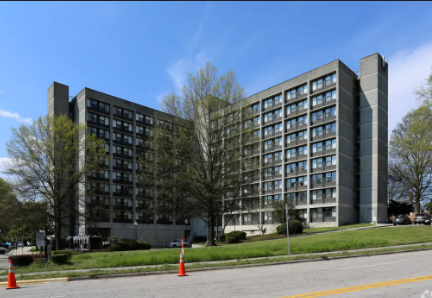
How did you get involved with JJ Henderson?
The manager at JJ Henderson had this room that had all these canned goods and all this stuff piled up in it. The residents get what they call Senior Boxes – boxes with an assortment of food. What they don’t want goes in the room. They gave us space. That’s how I ended up doing a food pantry at J.J. Henderson.
It’s for the residents only. It makes it easier for us because I can schedule an appointment for someone and if nobody’s on my schedule before 11 o’clock, I’m going home.
That must be a relief.
Right now we have JJ Henderson, which is our first pantry. The Veranda at Whitted School Apartments has one. They’ve got us planting these little resident-supplied food pantries in senior communities. They’re building a pantry in the new Forest Hill Heights based on what we’re doing.
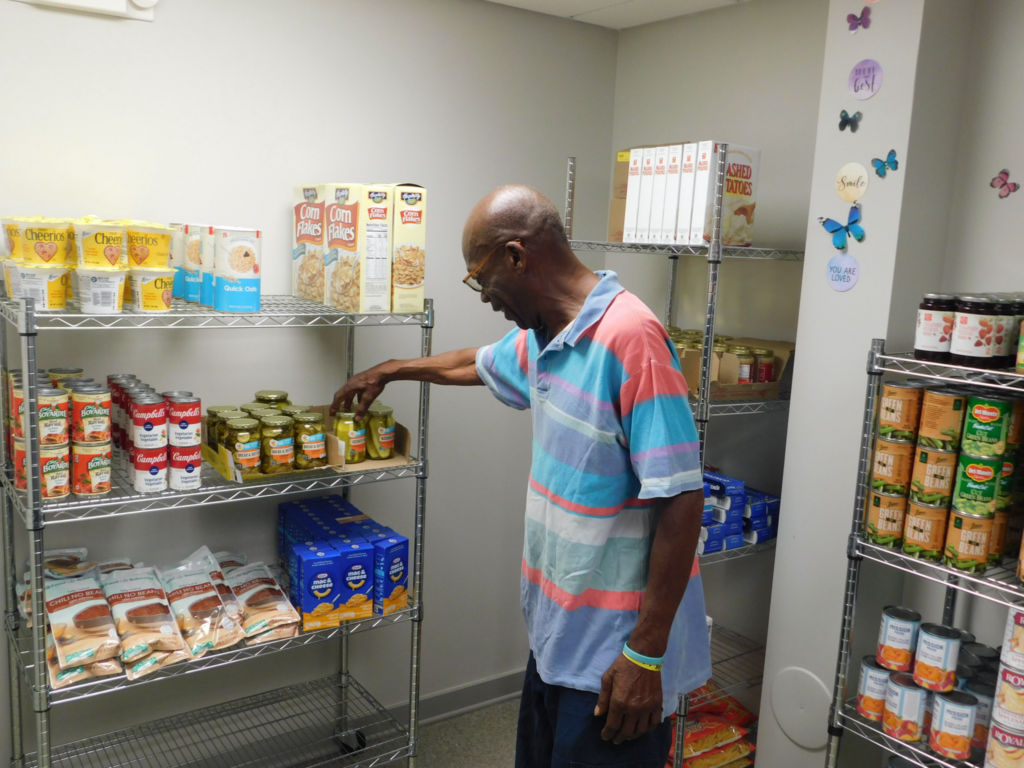
Ms. Blackwell, the tenants supply the food, is that how it works?
Yes. And that works out well because the tenant supply some food and we still get to shop at the Food Bank. Because Feed My Sheep is a food bank agency, we are allowed to go to the Food Bank and shop.
What is a food bank agency, please?
The Food Bank of Central and Eastern North Carolina allows you to go in to purchase what people donate to the food bank. If I need two of those items, one of those, or if I need a lot of produce, then I can get produce. It’s just another way of supplying your pantry. You can buy stuff from them. It’s a lower price than if I went to the grocery store. I might be able to get it for a few cents cheaper if I purchase it from the Food Bank than I would if I went through the grocery store.
Can you tell us about the food situation currently in Durham? Since COVID?
Even though Durham has a 12% food insecurity rate now, it was 14%. It has gone down in numbers, but pantry wise, their clientele has increased at least 60% since COVID. For instance at the Emmanuel Food Pantry on Roxboro Road, it started out with maybe 60 families and they had a hot meal. Then they went to 600 families. Now there are 850 families. The need has increased because the cost of food is high. Food is very expensive.
Then there is the uncertainty of whether or not people are going to get SNAP this month. (This interview took place when SNAP money was being withheld from recipients because of the fall 2025 Federal Government shutdown). Those things are really affecting people. The main thing is food is so expensive. If you are a senior, you have to reapply every six months for SNAP, whereas before it was once a year.
If I was a senior who didn’t drive and I had to go downtown to fill out a form every six months, at some point there may be a miss in my benefits. We discovered that people look for meat because meat is their biggest, most expensive thing. They’re looking for pantries who have meat because it’s rare. If you have TEFAP, which stands for The Emergency Food Assistant Program, you may get federal government meat. But if you don’t, you either have to buy it or you just don’t have it.
One of the things that we decided to do is teach older adults how to cook certain vegetables. We have lots of sweet potatoes and you have beets, broccoli, things like that. As a senior, these vegetables maybe difficult to cook. We try to teach the seniors how to cook the vegetables and encourage them to pantry hop. People don’t like it, but I encourage people to pantry hop.
Say if I go to a TEFAB pantry where I get meat and I get cans, but I need some fresh produce because my doctor put me on a special diet, and I can’t afford fresh produce. So you go to a pantry, you get this, this, this, this, You need fresh produce, you go here because she’s giving away produce. You go and get in that line and get whatever else you need.
Older adults can’t always stand in line. That’s why we do appointments at JJ Henderson. I only do two appointments per time slot. Because what you get and who’s using the pantry, is your business. They choose whatever they want. You go in one door and out of another door. There’s privacy. “You need some incontinence pads and you don’t want anybody to know?” We kind of work it out like that.
How can people help?
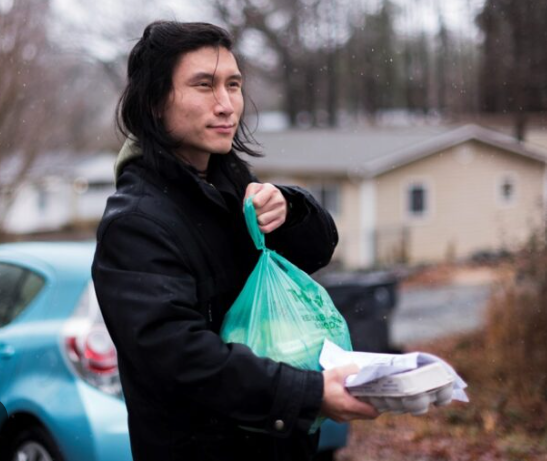
We need volunteers. We always need somebody that’s going to be able to come and help. To help people. Just pick one. I just tell them, “Just pick a pantry and ask them because their phone number’s on there. Ask, “Do you need some help today? I’m available.”
One of the things that we noticed is that people would donate food, which we don’t mind taking the food, but there are other things that pantries need. So If you’re like Feed My Sheep, we’ve had to pay rent or we had to buy paper bags to put the food in. Or we’re doing a cooking demo, we need a place, you know, those types of things. Monetary donations work for us to be able to buy those things.
Is there anything you’d like to leave us with?
We get a lot of cultural things. We have a huge discussion about that – about things being “culturally relevant.” I said, ”We live in North Carolina. Where are we gonna get that? Nobody grows it.” It’s hard to please everybody. So instead of it being “culturally relevant,” let’s be regionally relevant. From the Western part of North Carolina where I haven’t seen tobacco growing, and then I come to the eastern part of North Carolina and that’s all I see. And I’m like, “What is that?” You’ve got to figure out how to make what you have – work. That’s the thinking of how to cook a dish and adding your own ethnic spices. You know, “Get in where you fit in.”
The work is rewarding. Don’t get discouraged. If you’re helping a pantry out, continue to help them out. Be consistent with it. Be consistent with it and encourage them to continue. I think my biggest thing is to not assume what people need. What you think someone needs is not what someone needs. There’s a lot of that when it comes to offering food to people who live in housing projects. “Oh, they live in a housing project, so they’re gonna need this.” They don’t. They need something that you haven’t even thought about. They may need diapers or they may need more information about something.
*The pantry is a function of End Hunger Durham, which in turn is supported by Durham Congregations in Action.
**Betsy Crites was one of the first people to be interviewed for this newsletter.
Mrs. Blackwell is the Executive Director of Feed My Sheep of Durham; a food pantry that offers “Hope, Healing and Hospitality by providing groceries and a hot meal to those who suffer from food insecurity.” She has also provided summer meals to children and hot lunches to seniors and the people who have disabilities. She has a long history of community involvement and lives in the Northeast Central Community of Old East Durham where she serves many of her neighbors. She is a graduate of North Carolina Central University.