AWD spoke with B, whose job with the Durham Center for Senior Life is Health Promotions and Nutrition Coordination. AWD asked them about their work as it relates to the LGBTQ+ community, as gender identity and sexual orientation are cross-cutting issues in the Durham Comprehensive Aging Plan. Social participation is a key domain in the Aging Plan as well; many adults (particularly individuals from communities that have been historically marginalized) suffer from isolation and loneliness.
June is Pride Month, but the Durham Center for Senior Life has LGBTQ+ pride all year long.
What is it you do for the Durham Center for Senior Life, B?
I run evidence-based programming and all of our nutrition programming. Before I took on nutrition, I was a program coordinator. So now I fill in the gaps of our programming, where things are needed because we are only a team of three and sometimes we are stretched quite thin. One of those we–the three of us–used to tag team running was our Aging with Pride programming. I took on a large percentage of that just because I had room on my plate.

Please tell us about Aging with Pride.
I honestly don’t know how long we’ve been having Aging with Pride. I know the Center went through a big upheaval during COVID where we had to close, and then had to reopen being only outdoors. We slowly integrated into being back inside. That really restructured a lot of our programming. Most of our outdoor programming that we started with was largely exercise based. We weren’t doing as much socializing. It was more to get people moving.
My director, Noah Penny, has largely been the primary driving force for Aging with Pride, but I am not sure if he created it when he started here or if he just took over what was already in place. Mostly it’s been his project. The three of us are all on some form of the queer spectrum. We all find it very important to ourselves personally. We are all happy to tag team and now and again pass the ball whenever. Whenever it’s needed.
So it really sounds like it took off after Covid happened.
Yes.
And then you all went back inside.
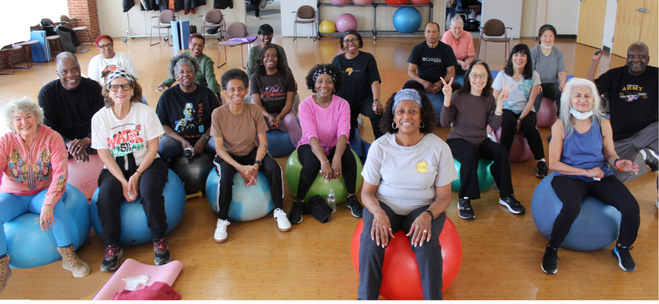
Yes. We tried to host a variety of different socializing groups that our members wanted, but we also tried to strive to meet the needs of those more niche groups that maybe weren’t as in for it, but we wanted to provide a space for those in case they wanted it. Right now, we’re trying to up our Asian American attendance. We don’t have many Asian Americans in our center, but we still want to represent them. If they want to be part of something that is specifically for them, we are trying to do that.
What does Aging with Pride look like? What kinds of programming?
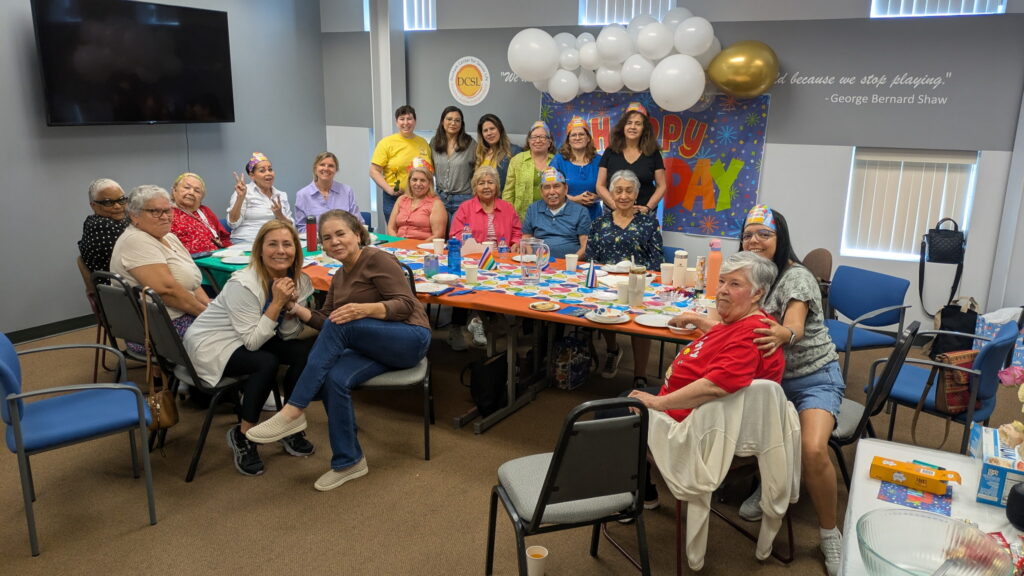
Our regular programming is a social group. It is one hour twice a month. It is a one hour time where we invite anyone who wants to participate to just sit down with other people who are of the same variety who want to socialize. It is facilitated by a staff member, usually me, to grease the wheels so to speak, to bring them to the center regularly. They are only coming for the Aging With Pride. Some of our other members go to everything that we offer.
It’s a very diverse group who don’t always know how to talk to each other.
It’s always on a Friday, and it’s always at 2pm but which Friday depends on which two work out best for us. There are usually between 2 and 5 people.
Social participation is a big part of the Durham Comprehensive Aging Plan. AWD is very aware of the importance of socialization for older adults. Can you speak about that a little bit and what this does for people?
Some of the members that we do see coming to Aging With Pride, we don’t see otherwise in the center, and sometimes we won’t see them for a few weeks. We just had a guy named Bob. He was out for a bit for surgery, and he’s just started to come back. He said to us at our last meeting, “Yeah, I was ready to come back.” Even then it was a struggle for him to socialize. It’s a struggle to get out and do something. But it is easier when you are going to something that is tailored to you.
You’re not just dropping into a very vague socialization where it’s a lot more pressure. Our regular socializing downstairs is a huge open room, and you have to find somebody to sit with. Unfortunately, we have some cliques that form and they don’t want people to join them. When you have a tailored group that is specifically for you, it’s a lot easier to come out and sit down for one hour twice a month. It’s minimal commitment.
The data is that social participation is not only great for mental health, it’s good for stress relief and even cardiovascular health. It’s really important.
Yes. The other thing that we do for Aging With Pride is we host a Pride movie once a month.
At the Center, we run Monday movies and Friday movies. We host a special Pride movie on a Thursday sometime. It’s usually the third Thursday of the month.
We source the group: “Anything you want to watch?” We’re getting to the end of our suggestions. We’re going back to what we’ve done previously and we tried to make it something just for them.
With the movies, we see that some of our regular members love movies and so maybe they’re being exposed to things that they have not thought of before or really been integrated with.
Yes, exposure is great. What kind of movies have you shown?
We’ve done everything. This month we are running two movies for Pride. One of them is “Imagine Me and You” from 2005. One of them was Bob’s suggestion, “All Over the Guy” from 2001. We’ve done “The Bird Cage.” We’ve done documentaries on Marsha P. Johnson.*
Sometimes we do like a few episodes of “Will and Grace.” Trying to keep it a little more variety based. So it’s not just like sad documentaries or rom coms or something.
Fun! What’s the attendance like?
It is small. We don’t see as many as we see for our regular movies. But we always–even if we don’t have anyone–we’re still going to play the movie and we’re still going to be at the social meetings just in case people drop by.
Absolutely.
We want to have that consistency that they can depend on.
I think you spoke to this earlier, but that regularity is really important to people. That structure is very soothing.
Yes, we see that at the Center, things get disrupted in their routine, they’re immediately out of place. They’re worried, they’re anxious, etc. We try to minimize that as much as we can.
Why is having a queer space in the DCSL important?
As a queer community, we have lost a lot of people over the years, not only during the AIDS crisis but with the natural progression of aging. We want to be able to retain a space for those individuals of this populace so that they know a place of community is always accessible to them. Especially as our country trends towards more outdated ideas in the coming years. And, like we talked about, as with any population, having a space for community that is solely intended for them brings about the many benefits of continued socialization. It’s also a great way, as with our other population-specific groups, to bring people together who may not know that others exist.
What would you like to leave us with?
I like to plug our programming all the time. The LGBTQ Center of Durham just moved in again, back across the street from us. They are back on Hunt Street. So we are in the process of asking them, “Do you have older adults that come to you regularly that don’t have a space?” Because we have the space, and we always have this regular programming, and we’re trying to coordinate better; what can we do together to bolster what we are offering? And then we always try to have programming during Pride. I’ve just scheduled our Pride events, so those will be in the newsletter.
What are you doing for Pride?
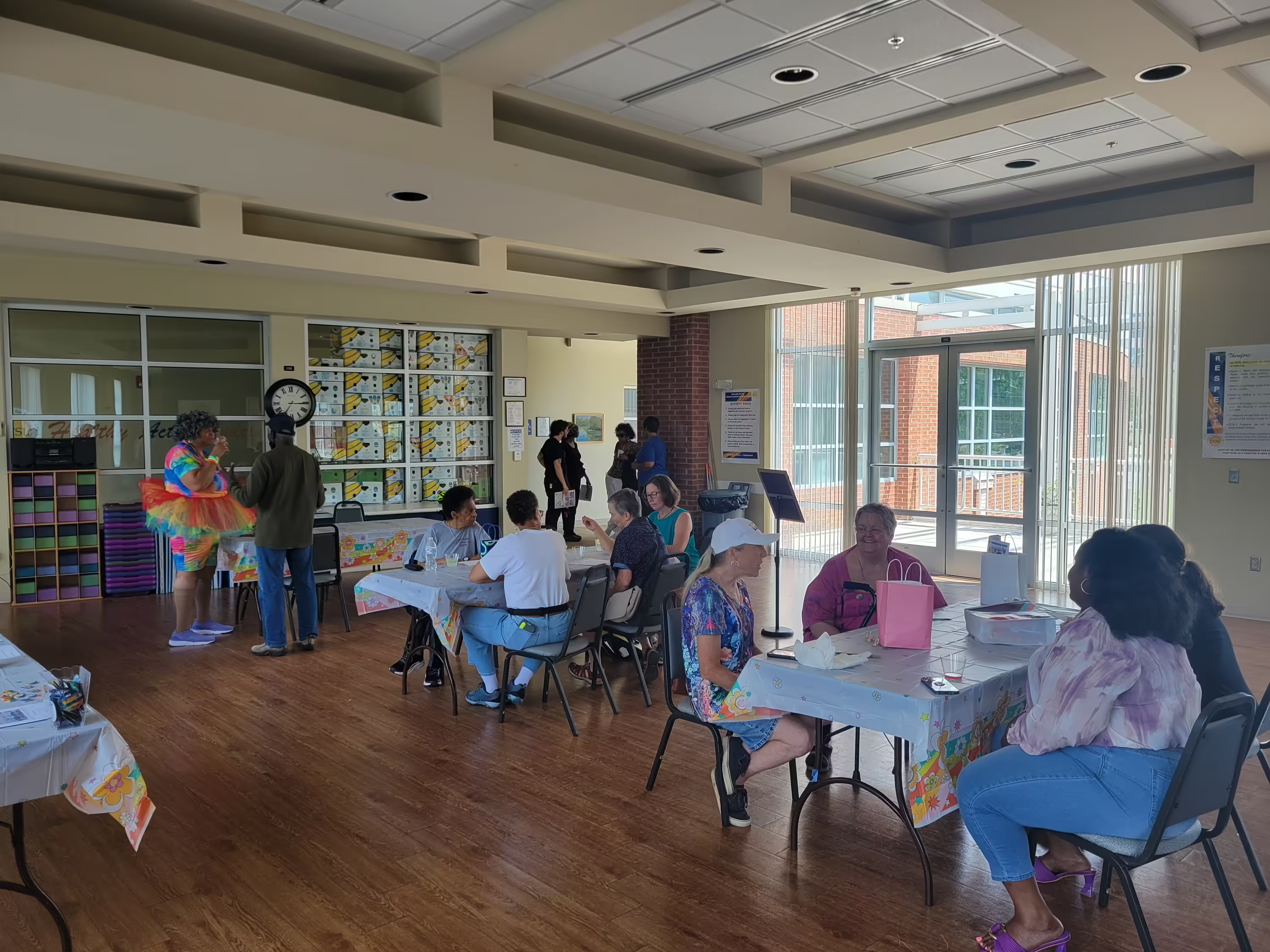
We’re doing our regular meetings. We have one on June 12th. We have one on June 26th. That’s the Fridays. That’s 2:15pm in the classroom. We’re doing two different movies. We’re doing one on Thursday, June 11th at 3:00pm. That’s “Imagine Me and You.” Then we’re going to do an evening one Thursday, June 25, at 5:00pm, “All Over the Guy.” We’ve switched our Pride movies now that we’re open later in the summer. We’re doing them mostly at 5pm, but sometimes we run them at 3pm. We did two different ones to get both groups all aware. On our Friday, June 12th meeting, we’re also doing a potluck picnic.
LGBTQIA+ Meetings: June 12th Potluck Picnic, and June 26th, Friday at 2:15pm
June 11th, 3pm: “Imagine Me and You”
June 25th, 5pm: “All Over the Guy”
We’re asking our members to bring a little something to share. We’re going to supply a charcuterie board just to have a little something as we celebrate our community. We’re going to have some Pride themed plates, tableware and stuff like that.
I don’t know if you remember back in the day in the 90s, they had the Shrinky Dinks. We’re going to do keychain making. If you want to make your own Pride symbol..
We do trivia as well. We do a trivia day. This one’s always intergenerational, so we open it out to all ages.
How is that going?
Not the best. We don’t see the younger crowd coming to the space, which is on the one hand, fine, because we are an older adult space and we don’t do many intergenerational things.
I would like to see it more specifically of the pride group just because I feel like that might be more meaningful than maybe other groups who are socializing in that way.
The data is that intergenerational programming is great. It’s good for everybody. It helps their health and mental acuity. It’s great for everybody. But getting everybody in the same room…
Yes. We’ve seen that for sure. But we always try. We do our intergenerational trivia for Pride. I make Pride trivia and I buy queer artists or queer author books or queer theme books. Those are the top three prizes. So far we’ve done it. I’ve done it a few times now. It’s been successful for the people who do show up.
*Marsha P. Johnson was a performer, sex worker, and activist who is known for her participation in the Stonewall Riots, and her advocacy for LGBQ and transgender rights, and care for people with AIDS. She was the creator of STAR, “Street Transvestite Action Revolutionaries,” which had a house in the East Village in New York City for transgender youth.