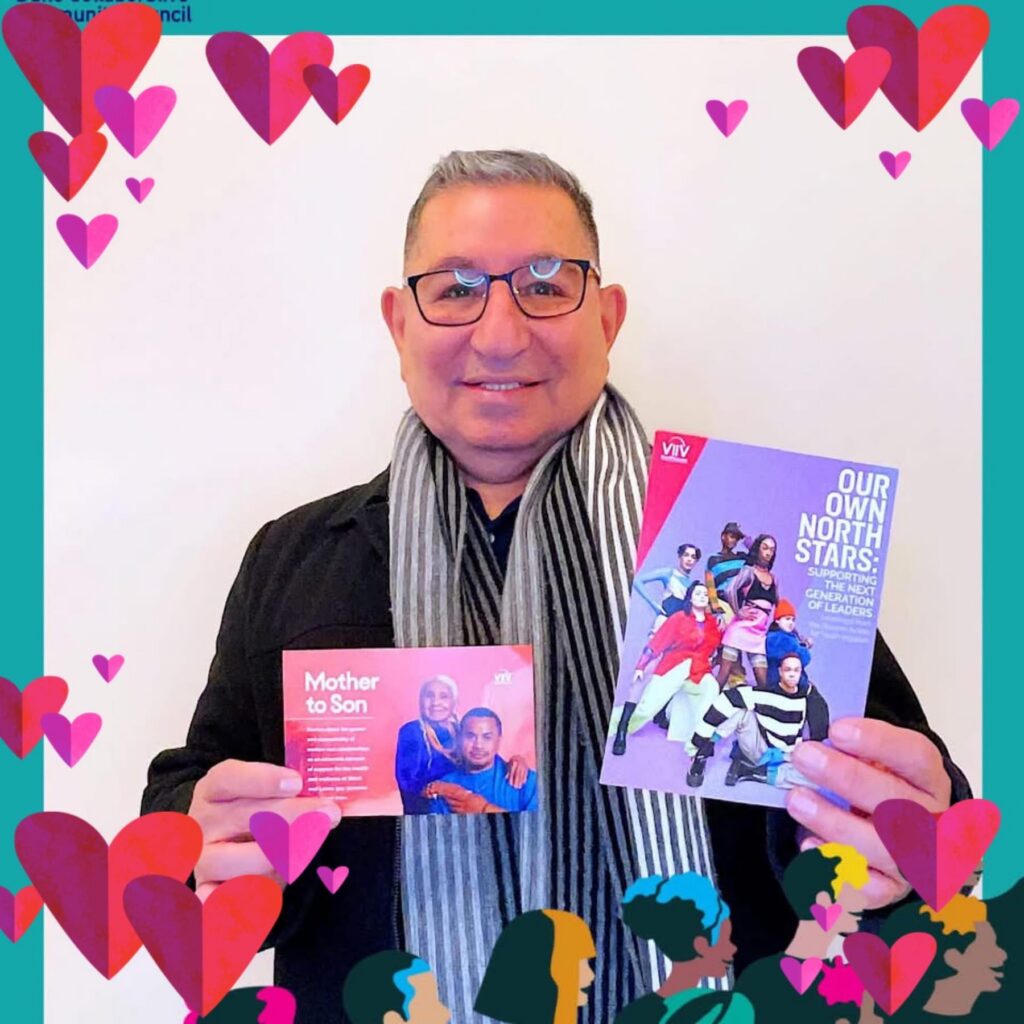
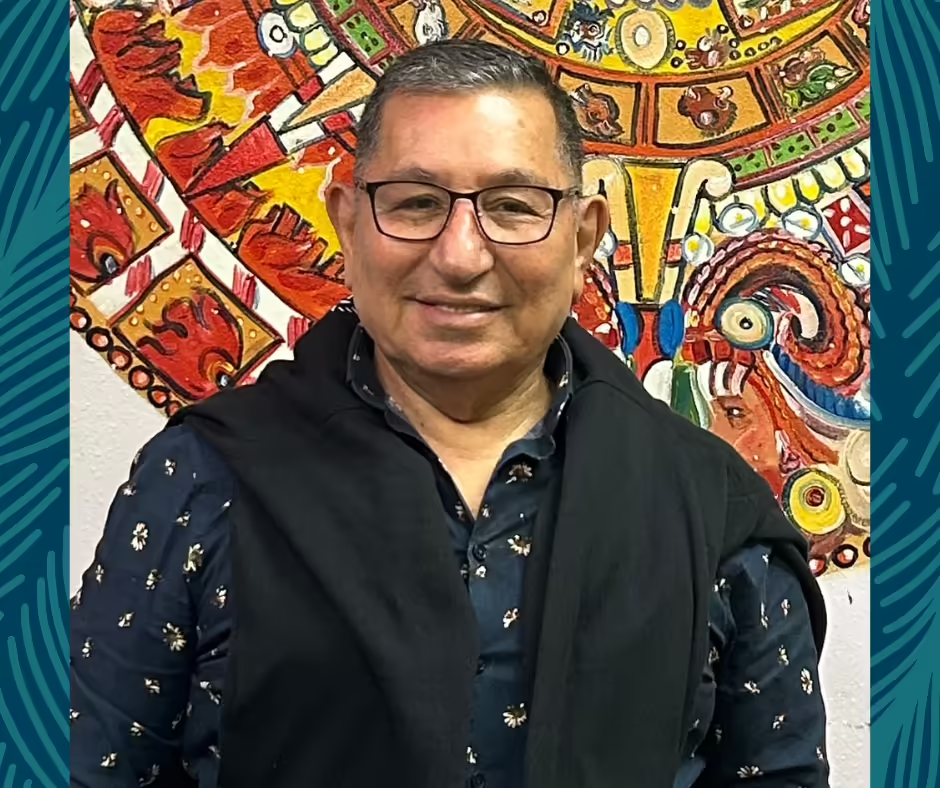
Alex Cordoba is the Executive Director of LILA NC, an Durham organization that works to create national change. “LILA promotes equity for Latinx, LGBTQI+, and BIPOC communities through leadership development, advocacy, and community programs in North Carolina and beyond.” The Durham Comprehensive Aging Plan also uplifts Latinx, Queer, Trans, and BIPOC voices, as part of the vision that Durham is a place where all people can age well.
The Social Participation Domain of the Aging Plan corresponds with Alex’s decades-long advocacy to create community. Alex deliberately uses the word “healing,” in connection with community. He is an original member of the Aging Well Durham Community Advisory Council, which meets monthly to ensure the Plan is working everywhere, via advocacy, action, and more. (If you are interested in joining, email Shelisa@AgingWellDurham.org)
Alex, can you tell us a little bit about your background?
I am from El Salvador, and I have a Bachelor’s in Communication. I was also an RN nurse in El Salvador. Everything is in El Salvador. I got here with my kids in 1989 and that was because there was a war in El Salvador.
I got divorced, and so I asked myself, “What does a newly divorced man do now that he is in the United States?
Around that time I was living in California. A friend of mine invited me to go to this meeting–an LGBTQ meeting–for some reason. Maybe because I was a programmer in San Francisco, my educational background, but whatever it was, they asked me to teach a class.
That class was a support group for LGBTQ people, and that’s how I started to learn about them, all their needs and challenges. I helped many initiatives there, and we created a lot of support for the LGBTQ community.
But my full-time job, or my official job, was in the hospital, and this was for older adult people.
Before doing what I am doing right now, I went to college. I did all my education at a college level, and also I got my bachelor degree.
That was in communications?
No, that was social work.
In 2005, somebody hired me to come take care of a patient here in Durham and I came for two months. After a month, I saw a lot of need here. I saw the opportunity to come to Durham and I saw the opportunity to do something better and bigger here, because I already had walked that path in California.
So you’re a natural activist.
Yes. I connected with a friend who worked for the Hispanic Center, and they had an idea of creating a group for the LGBTQ community. I became a volunteer, and I worked for the Hispanic Center for 10 years. I started as a volunteer at El Centro Hispano, and that’s how basically I started here.
Did LILA (Alex’s non-profit organization for Hispanic LGBTQ people) come out of that experience?
I started at El Centro Hispano as a volunteer, and then I was an employee over there. I was the creator and director of the LGBTQ group, and we had a couple of different groups.
What were the groups you had at El Centro Hispano?
I had a group of transgender women called “Nosotras.” I had a group called “Mujeres en Acción.” A group of young people called “Hola.” There was a group of people over 40. Some of these groups were transgender. Those were focused on women mostly, but also teenagers and also older adults above 40 years old.
Amazing. That’s incredible. So how long were you doing that before LILA was born?
Ten years.
Wow. Gracias. Where did you go then?
After I was not working with El Centro Hispano, I retired. But I am a member of a church, and they invited me to do a LGBTQ group. At the beginning, I said no, because I was not sure how to start. But then they helped us to do all the paperwork and how to start a nonprofit organization.
What church was this?
The United Church of Christ in Chapel Hill.
What I’m curious about, Alex–and you know this–is that social participation is crucial for older adults and probably marginalized people even more. It’s a domain in the Durham Comprehensive Aging Plan. Can you talk about these groups and the importance of social participation? What it does for people?
In 2018 we started the organization. We started at the church and then we rented the place where we are now, which is here in Durham. The organization is basically for LGBTQ Latinx people who speak Spanish, who have a language problem, and the majority are people who don’t have another language. So, we created three programs, Education, Advocacy, and Health. But along the way, we found two questions. There are people in the LGBTQ community who are older adults, and on the other hand, the Latino community itself has older adults, and I am an older adult.
While we were working on these groups, we found a couple of issues that the community was having, and that is that the Hispanic community has a lot of older adults, and it makes it even more difficult. I am an older adult as well.
One of their problems was that, for example, transgender people or any member of the LGBTQ community were getting older, but they didn’t have health insurance. They had to go back to their family–where, basically, I call them abusers because they didn’t treat them the right way–because these people didn’t have another option. They needed someone to take care of them.
And, they’re in a country where they can’t speak, necessarily, navigate the language. That must add another layer of complications and stress.
When I met Shelisa (Howard-Martinez, the executive director of AWD) , and I knew that there was a program, I was interested in finding out what was going on, but I also had to be realistic. That’s how I met Shelisa. I realized that she was working with older adult people, and that’s one of the reasons, basically, that I came to Aging Well Durham. I would like to talk to Shelisa and the entire group (Community Council) about the challenges that the LGBTQ community is having, or Hispanic LGBTQ community is having.
Since they don’t have health insurance, it is hard for them to get healthcare as well.
Is there anything you want to say now within this platform about that?
Well, there are a few things here that I know I repeat over and over, but I would like to see a change.The first thing is that most of these people don’t have a social security number, so it is almost impossible for them to get health insurance.
And, also, they do not speak English. From my perspective, I am a Latino man, an older American citizen. I think I can do or propose within this organization, Aging Well, I can be a voice to be able to do something. Doing something, I think that my proposal is to make a statistic of the families that have older adults and train a relative about the emergency skills to be able to help an older adult to start.
One of the things that I would suggest is to try to find data about how many Hispanic older adults are in the community and to train one family member to take care of them and to train them how to navigate the health system so that they can find resources for the older adult.
That would be a fantastic project.
Yes, I know it is hard to get the money to finance this type of project–that happened to us when we started LILA–but I think we could find a way to finance a program like this.
I imagine so. How did LILA emerge from this activism?
It started with the idea that I could not stay at home, that the community needed us to do something for Latinos in Spanish, that the majority of people who did not have documents were basically from the LGBT community. After I retired, I thought that I was not going to do anything.
Then a friend invited me to a coffee, and that’s how I had the initial idea about LILA, because he said that I couldn’t stop working if our community was having so much need for things, especially people who speak Spanish, which is the group which we focus on. And that’s how LILA started, just in that coffee shop.
Our focus is to work with Hispanic people, LGBTQ Hispanic people. But our vision is to educate everyone to reduce the challenges that LGBTQ group is having.
That’s amazing. And what does LILA do? What is the concept or mission?
Right, because white people need to know. Everybody needs to learn. We all need to learn.
Yes, that’s right. I think everyone should know. A good example of that is that we have a group. It is called “Between Friends,” “Entre Amigos” in Spanish. We train all people there. It doesn’t have to be only LGBTQ, but everyone who wants to come and talk to us.
Another program that we have that is not just focused to LGBTQ, but we teach people about it. It is called Noches de Barrio, and basically what we do here is people dance and there’s Hispanic food.
Oh, okay.
When we have all these people together is when we start talking about the LGBTQ community. But when we are inviting people, we just don’t invite LGBTQ people, because we want to teach other people as well.
Right, that’s really important.
Just to make an emphasis on this, every time we have a gathering, we focus on a specific country. So it is going to be the dance of that country and food of that country. And it is fun to be there.
I bet. That sounds amazing. I want to go.
We also have a curriculum called Enchanting Women. And this is for women, to empower Latin American immigrants who come to this country and who come to be part of the labor force.
This group basically focuses on women who just got here in the United States. So we teach them about how to talk in public. We teach them about the health system. We ask them how they define happiness, if they are happy or not. And many of them say that they are abused. So that is a big challenge as well.
We also have for North Carolina organizations , not only Durham, a workshop called “¿Entiendes qué significa LGBTQ?” (“Do You Know What LGBTQ Means?”) for the employees of non-profits.
We do it before they start working. We have breakfast and we empathize. If you don’t understand what LGBTQ is, you can’t work with your clients, you can’t. You have a gay brother, you have a friend, you have a community, and we want to decrease the stigma about the community, LGBTQ in North Carolina.
Our main topic in those meetings is to ask people if they understand what LGBTQ means. Because if they don’t know what it is, it is impossible to treat people in the LGBTQ community right. They won’t know how to treat them well.
Right. I mean, you’re talking about a population that’s already marginalized plus LGBTQ. That’s got to be rough.
Yes. And we teach this class because this is a class. Anywhere in North Carolina, we go to the mountains, we go wherever there is a need for it.
Amazing. That’s incredible. What can you tell us about the Latinx older adults, LGBTQIA?
Yes. This is one of our challenges. When this community retires and they basically don’t know how to spend their time, most of them, or many of them, become addicts or they are depressed. Our job is to create activities so that they can join and they can talk to other people and, you know, have that sense of belonging.
I was going to ask about the outcomes for older Latinx people. Addiction is a terrible problem. So it sounds like socializing brings about a community, sense of community and connection. That’s crucial. And healing, right? On your website, you mentioned the phrase “how to heal.” Having in mind that the Hispanic LGBTQ community goes through a lot, do you think, it is in part due to “machismo” that also might be present?
I don’t know exactly what it is. Culturally speaking, when we come to this country, we bring our entire culture with us, including ”machismo,” codependency, dominance, and so on. Consequently, people arrive in a system they don’t understand. People encounter things they never imagined they would have access to, and they get swept up. I’m talking about drugs, alcohol, and all those kinds of things. So, healing becomes essential.
And if we don’t heal, things go out of control; we’re going to end up harming ourselves. So, when we arrive in this country, we bring along all our traditions and the ways we behave back in our home country. However—and this is key—the only way we can survive and build a better community is through healing. Therefore, we really need to work on healing the community. That is why I use that specific word on my website. Yes, and I also use that word because—well, the question remains: “how” do we heal?
I am very much opposed to the current situation with mental health initiatives—the workshops, the training sessions—because people aren’t healing. We’re just trying to reach goals and numbers. So, at LILA, we have a different kind of program. For instance, we have theater, and that serves as a means of healing because sometimes—despite all the classes and discussions we have about healing—people don’t truly understand what healing means.
I believe that activities like theater can really help them. And for us, it is incredible to watch: individuals who have never set foot in a theater reach deep inside themselves to pull out a character—they bring it to life—and when we put them on stage, they feel a sense of joy. That is healing. It is truly remarkable how people sometimes create their own characters, and how this process helps them heal as well.
I can see how through that character, they can say things they might otherwise be unable to say without fear.
Yes, but what I do is write the stories of a woman who came from her home country and is now a transgender woman. I write our real-life stories to bring them to the stage. To heal and find catharsis, but also to educate the audience that see us. The way this program works is because I write the stories. For example, let’s say there is a woman who comes from a Hispanic country, then arrives here, and is now a transgender woman.
So, I write her real-life story, and the performers simply interpret that specific character; yet, they can fundamentally identify with them because those stories are written from real life.
That is incredible. That is truly beautiful. And that is the community.
Yes, exactly. And I just want to add that this also helped them heal themselves.
Absolutely. That’s so good.
Yes, absolutely. People are engaged. People are learning. People are looking inward, and people are happy. One thing that I want to add to that, to those programs is that people are learning. People are busy. They are happy with what they are doing.
So there are positive outcomes from the programming. It sounds like great work.
And you know what? For this type of activity, we don’t have any grant money. So I have to do activities that give us money and that’s how I finance all those activities.
Wow. I hope that putting this out in the newsletter opens some people’s eyes and gives people an opportunity to think differently.
We need money.
I just want to let you know that my work is not just with the LGBTQ community, but also the Hispanic community in general. I will go to Washington this coming weekend, and I am going to advocate for the rights that have been taken from some immigrants. I want to advocate for this woman who has been detained because she has AIDS, and she’s transgender. She has been there for two months now.
Thank you for doing that work. That’s really powerful. The time we’re living in is particularly challenging for Hispanic people, right? Are there other organizations that you have strong alliances with, or you’re out there hustling for yourself, basically?
No, no, no. Now, if you remember, in 2020, when COVID started, we were at this Zoom meeting, and everyone wanted to have connections with the Hispanic community, but they didn’t know the Hispanic community.
Right.
At that point, I met this person from Amex Camp, and I proposed that we could create an organization or an alliance for Hispanic people, and it is called “NC Latino.” This alliance has ten different organizations, and we support each other. For example, in the next couple of years, there is an activity in Henderson, and we will go there. Everyone is going there.
We’re running around the clock, so I just want to give you an opportunity. Is there anything you’d like to say, put out there for people to read?
Yes, we are allied with many other organizations, not only in North Carolina, but nationwide. For example, we are in the same group with “American Alliance.” I am part of the board.
Fantastic. Alex, you do so much, so much for the community, for not just the Hispanic LGBT community, but for all of us, and for that, I am so grateful.
I also want to add, and even I didn’t know this, but the other day I heard that we are the only LGBTQ Hispanic organization in North Carolina.
Well that needs to change.
Just so that we don’t get people confused, many organizations have a group, right, but we are a full nonprofit organization focusing only on this community. And I just want to say that that community out there loves us, they respect us, and they really like us.
Bueno, I love it. Thank you so much.
I just want to add that I came to Aging Well Durham because I am a gay man, I am an older adult, and at one point I will be gone, so I want other people like me to come and join these kinds of groups. I want to create a road for other people coming after me.