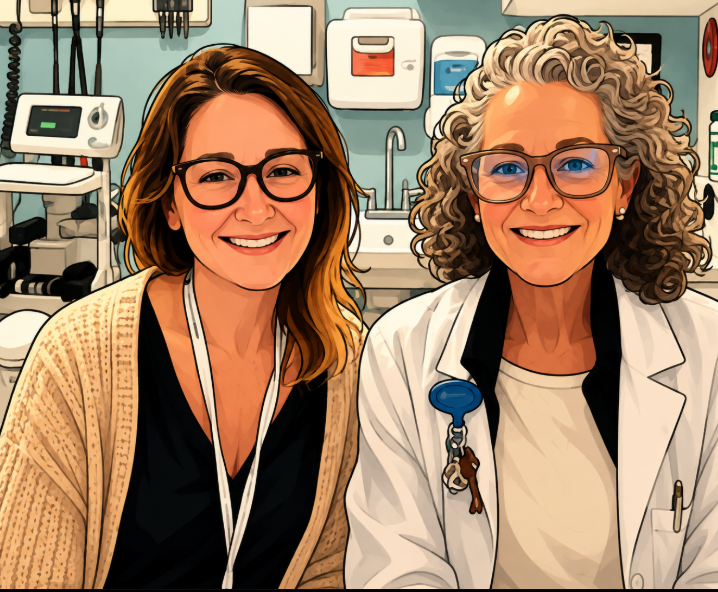
Beth Soule, MSN, RN, CCM and Angela Burnett, LCMHCS, spoke with Aging Well Durham about their experiences at Duke Primary Care in Knightdale, finding ways to intervene, interact, and prevent their clients from suicide or ideation.
Beth sees Medicare patients, who are generally 65 and older, for annual wellness visits, chronic care management, as well as advanced care planning. During a wellness visit, she routinely does a PHQ-9, which is a screener for depression, and a GAD-7, a screener for anxiety.
Angela is a Behavioral Health therapist and a licensed clinical mental health counselor. After Beth screens clients, she may refer them to Angela for further treatment.
Hello! Let’s jump in. How does this work, this relationship between the nurse, counselor, and client?
Angela: I get patients from Beth, but then I also get them from their primary care providers if they come in and we do screenings. They’ll do the GAD and the PHQ-9. Whenever a patient comes in for their sick visit, wellness visit, depending upon their score, their discussion that they have with their PCP, they’ll put in a referral for me or someone among our team.
BETH: I ask those screening questions just to be in front of any mood problems that there might be. I also screen for gun safety and storage. You got me (to interview) because I was the one that wrote the screener and steps and regular documentation, as well as the information we share out in terms of with the patients.
We also give out gun locks.
Yes, I have one!
Duke gives these free.
I got it free from a Duke Health table at a conference. I don’t even have a gun.
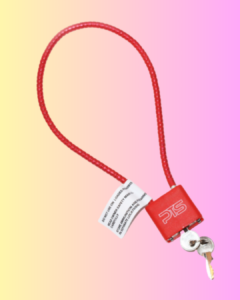
BETH: Give it away – have somebody use it. We’ve partnered with the Duke Firearm Injury Prevention Partnership and with Durham County and Public Health. We give these out free as we assess and make sure that people are medically able to own a gun. Usually they say they own one gun, but, you know, if the guy has five guns and none of them are locked away, he gets five. Five locks.
Wow. That’s great. (Visit the main office, Durham County Department of Public Health, 414 E. Main St., Monday through Friday between 8:00 AM and 5:00 PM or contact them by phone at 919 560-7765 to get a lock or lock box as well.)
That’s what we do, try to be in front of things. In a nutshell, that’s what I do for Wellness. It’s all about prevention.
Chronic care management is across the continuum, and advanced care planning is just to make sure that people have their P’s and Q’s in order on their wishes. Part of the deal with that is to make sure that in their final days, we’re delivering care at the level that they’re wanting, that they’re not intubated in the ICU with nobody being able to visit.
End of life planning is one of the goals in the Community Support and Health Services domain. I have a lot of questions for you, but thank you, Beth. Angela?
So I am fortunate enough to work with Beth as often as possible. I am a behavioral health therapist. I’m a licensed clinical mental health counselor.
I get patients from Beth, but then I also get them from their primary care providers (PCP) if they come in and we do screenings. They’ll do the GAD-7 and the PHQ-9 that Beth referenced. Whenever a patient comes in for their sick visit, wellness visit, depending upon their score, their discussion that they have with their PCP, they’ll put in a referral for me or someone among our team.
We provide services in-person as well as virtually.
I see a lot of patients that have anxiety and depression. Typically, whenever someone comes in, we do the PHQ-9, and there is a number 9 that’s a reference to if they’re having suicidal thoughts. Then we would escalate to what we call an ASQ (a suicide screener). They ask “how severe are those thoughts?” Then we escalate that further.
We make sure the person is safe. We both work under the umbrella of Population Health at Duke Primary Care, not under psychiatry, not under DukeWell, which is also a place that you might find population health nurses as well at Duke.
So we work directly in primary care with the primary care population, not as an ancillary, if that makes sense.
Yes, that makes sense. Do you have a lot of older adult patients?
ANGELA: Yes, yes. It’s been kind of fascinating being in this role. Getting to work with individuals that are 65 and older because that population may have never worked with a therapist or the stigma around mental health was different when they were in their 20s or teenage years growing up.
So a lot of things may have somewhat snowballed by the time they get to their 60s, 70s, 80s.

They’re processing things from years ago that have been tucked away in other spaces and they’re dealing with new issues, whether that be medical illnesses, caregiver stress – whatever the case may be. There’s older issues as well as newer issues.
I didn’t think of the backlog. That there might also be early issues, trauma.
I’ve been thinking about aging, as you mentioned, and the things that come along with aging, like losing abilities or losing people, that may make some tend towards depression.
ANGELA: I do hear the word burden a lot. It’s always interesting, some of the words are similar in different sessions. They don’t want to be a burden to their children or other family members, or they’re isolated, so they don’t want to be a burden. That’s always a little red flag for me whenever I hear that word.
BETH: Yes, that’s a small word but huge in the topic that you’re actually wanting to talk about because of perceived and real burden.
Yes. When you hear that, you’re like, ding, ding, ding, red flag!
Even if they don’t reach the thresholds with the screening tools, I say, “Do you feel like you would benefit from being able to talk to somebody?”
So regardless of the value, it’s the perceived burden or the perceived need that I will act on. I actually encourage folks to call me. I only get to see them once a year, but if they need to get in to see someone, let me do that, get out those questionnaires. Regardless of the value, I will put in an order and we’ll get you to talk to somebody.
Oh, that’s good. That’s great to hear. So you’re dealing with an older population. They come in and they have a lot of general issues. What are other red flag issues?
BETH: One of the things that I do see a lot is depression over losses, bereavement, peers that are going away, family members that were taken suddenly or untimely, and they’re really having a very difficult time with that. That’s one of the things that I refer to Angela for is the processing of that grief. We also give resources for free grief counseling in the community. Some people feel like one-to-one, some people feel like a group.
So community bereavement services.
What we do is try to be in front of things.
When my mom died, my father and I took advantage of the Duke Bereavement Services. It was really helpful for both of us.
BOTH: Oh, wonderful! Great.
So you’re prevention, you’re upfront.
BETH: So I am prevention, absolutely. Angela’s treatment.
What can you say about that, Angela?
Well, it depends on the severity. In counseling there’s just a mode— what’s really more of an acronym, it’s called SLAP.
- How Specific is a plan?
- How Lethal is it?
- How much Access, like a gun or medication?
- If there is a Plan.
Once you’re screening someone–and a lot of this is just conversation, it’s not like I’m ticking off boxes. I’m just trying to get a natural, organic conversation going,
“Have you ever really thought about suicide?
What does that look like for you?
Do you have access to that?
Is there a plan?”
It depends on the tier that they go through. “No, it’s just, it’s just something I think about because I don’t want to be a burden.”
That’s passive ideation. We’re going to keep a temperature on that. Typically I see patients at least twice a month or once a month depending on where they land on our initial assessments and depending on the needs of the patient. If they’re feeling like this is working for them, like if they need that space to talk. If it progresses, then we’re definitely going to escalate that to a little bit more of an inpatient setting.
If they come in, they’re having ideation, when they leave, I’ll typically give them access to the 988 number or make sure they have a resource to call if it’s 3 in the morning and things are just not going well for them. If not, then I will escalate that to psychiatry for a mental health examination or psychiatric examination because it could be something that’s off, like a chemical imbalance. Our bodies change as we get older. We want to see what else is going on.
It’s not just contained in that one room.
Glad to hear that because I know, you know, as we get older, our medications may increase and that can create symptoms that look like dementia, for instance.
Exactly. Yeah.
BETH: And they do masquerade as each other. Speaking of red flags, one of the things I look for is if someone comes in with their service cap on: Marines, Navy, Army, the jackets, military symbols. That can be a flag. These folks know guns, they know how to use them, and they know what they’re used for.
The national statistics on gun safety and suicide finds that guns are the number one mechanism of suicide in the 65 and older population.
85-year-old men, apparently.
Yes, and peaking at 85. It’s men more than women, whites over Black, etc.
With every patient that I screen, I also say, everybody always thinks about guns. Even if they don’t have a gun or they do have a gun, I say our concern is the safety of the people in the house. Are any guns locked and loaded, or locked away, keys separate, ammunition stored separately?
We follow the SAFE guidelines. The SAFE-T (Suicide Assessment Five-Step Evaluation and Triage) tool helps health workers check if a person might try to hurt themselves. The five steps are:
- Identify risk factors,
- Identify protective factors,
- Conduct a suicide inquiry,
- Determine risk level and interventions,
- Document the plan.
There are some adults who shouldn’t be around guns, like friends or family with memory problems, PTSD, substance use, thoughts of suicide.
Even if they say, “I don’t have a gun,” I say “Are there children in your home, are there friends or family?” I go through it to make sure that we’ve heightened awareness. That’s really where I try to elevate, is the heightened awareness (that there is a potential for danger to others).
That’s really important. What happens next? I guess you’ve told me the next steps, which would be to get a psychiatrist and then possibly go off to treatment or ICU.
BETH: I cannot IVC someone, which is involuntary commitment.
ANGELA: I will emphasize, if someone is having suicide ideation and they’re ticking all the boxes, we don’t leave them alone. You don’t let them leave because they have to stay in your presence and you want them to, because clearly they’re going through something. They need support. They need support.
BETH: We will make sure that that person— it’s a handoff. It’s not, go up here, go home and call this person. Right. We’re taking you to this person.
IVC might look like a transport to the emergency department where they’re evaluated by our colleagues who are much better equipped: a physician, number one, because they may be seeing me without a physician to visit. They may be coming in to see Angela as a standalone visit.
Our colleagues in the community might be supporting us to the next step, which looks like mental health evaluation at that point, and then paperwork for involuntary commitment if they endorse the fact that the patient is of harm to themselves and/or others. And there’s a 72-hour hold with that.
Right. What would you like people to know about suicide and suicide ideation?
ANGELA: Normalize talking about it. Support community. Some people will say, “Talking about it causes it.” I’ve heard that before, but it doesn’t.
It really normalizes, “Wow, other people have felt this way or think this way and it’s okay to ask for help, that it’s safe to ask for help.” It’s preferred that you ask for help so that we can lower the temperature on it, so that we check in about their community support, making sure people are not isolating, calling a friend, just checking in.
Beth mentioned grief.
BETH: Grief is a big thing because when patients get to this stage, it’s not just that their partner passed. It could be that their siblings have passed, their aunts and uncles have passed. I’ve heard many patients say, “Well, everybody’s gone and I don’t have anyone.”
Part of the wellness visit with that structure of once a year visit with me, is: they hear it. I always say, “Talk about it.” I don’t care whether you share it up, share it out, just tell it because we cannot help you if we don’t know about it.
ANGELA: I usually highlight the fact that if your mood is keeping you from doing important things that you want to do, that’s when we move. If you hear someone say, “I used to like to do these things and I don’t anymore,” and I’ll ask, “Well, what changed? What’s changed for you? And then “How do we change it back?”
What do we need to put in place for you that you don’t have now, that you did once have?
That’s great. One of the things that I’ve been hearing— I just spoke with a psychiatrist. She was talking about the fact that men are reluctant to seek help and the disparity between genders.
BETH: That is a real issue.
And social isolation, of course, is a huge issue. Social Participation is actually a domain in the Durham Comprehensive Aging Plan, which we are the backbone agency for.
BETH: Yes, I would agree with that too.
ANGELA: Absolutely. Absolutely.
BETH: I normalize trying to talk about their mood. I really do.
I have to ask those questions if they’ve not already answered them. We do provide self-reporting, but if they don’t fill out through the iPad or the opportunity before their visit to share that information, I do ask those. I did have a gentleman who was in the military who had a gun in every room in his house. He even said, “When it’s my time to go, you won’t know about it. I’ll step out in the backyard and take care of it.”
That’s the stoic white male. Ultimately, he did find out for various reasons that he could no longer have firearms in his home because of a caregiver concern. And they were removed, all of them.
In order to keep his caregiver, he elected to give those up. But that’s what the conversation, opening the door, talking about it can do, right?
Yes, I was just talking with someone who was collecting data for the city with these really neutral, benign health surveys, and she said it was so hard to get the men to fill out the surveys. They wouldn’t even do a survey to win a smartwatch or whatever.
BETH: In terms of firearms safety Duke is one of the leaders in North Carolina. We are lucky to have a legal school, statisticians who have a branch of nothing but firearm litigation.
Whoa.
So Duke Legal has a whole thing on nothing but firearms.
We have the School of Statistics, we’ve got the School of Medicine, we’ve got Public Health, we’ve got School of Nursing, who are all interested in participating in a hub or a center, if you will, in order to organize research on gun safety, violence prevention, injury.
We’re rolling in all of the hospitals as well. As we’re starting to do the assessments, people are becoming a little bit less afraid to ask. Not only do you have people that are afraid to tell you, you’ve got providers that don’t want to ask the hard questions.
Oh dear.
Yeah. When we start to talk about gun safety assessment, they’ll say, “I’d rather talk about not driving than guns.”
Wow. To Angela’s point, we need to normalize the conversation.
BETH: The Center for Firearm Safety that we’re looking into building currently, whether it’s a brick-and-mortar building or just a group or virtual space that we meet in; we are trying to pull in the students like the School of Medicine and the School of Nursing to have those conversations, to go ahead and get it out there.
I’m trying to be proactive as a population health nurse and talking about those uncomfortable things like memory, like gun safety, like driving.
It seems like with all these stigmas, there’s hardly anything to talk about. Do you know what I mean? It’s hard to have a real conversation.
I think people want to talk about them.
Yes.
You have to ask. They’re not going to bring it to the conversation, right? You have to ask those questions because they probably don’t want to think about it.
“I don’t know what to do with that.” But if I ask, now they have to think about it, right?
Social isolation, as we mentioned earlier, is of primary interest to AWD. Would you talk about options, please.
ANGELA: You know, the senior center might be a great idea, but if they don’t drive and they’re homebound, How do they get there?
That’s right.
You’re isolating. How do we find other means for you to connect? If they are tech savvy, can they do online groups? Are there organizations in the community that will come to their house?
AWD is hard at work helping to get people connected to the community. Is there anything you’d care to leave with us that we haven’t covered?
BETH: The thing that I focus on is, it’s okay not to be okay. We can help.
Okay. Again, if you can’t tell us or report it, we can’t help. So it is okay to not be okay, right?
Yes, I agree with that 100%. Yes. People think they’re unique, that the pain and anguish they suffer won’t be understood. I think sometimes it’s helpful to let people know that it’s not uncommon, right?
ANGELA: Exactly. And, you know, the mood is passing, the thoughts are passing, so we don’t want to make permanent decisions on passing thoughts. Permanent solutions to temporary problems, right? Isn’t this something we always throw out there?
Yeah, absolutely. I love that saying.
BETH: Yeah, “Suicide is a permanent solution to a temporary problem.” And also, “Sharing it halves the problem.” In other words, it’s not all mine anymore. I’ve shared it.
And then when— with the sharing, we can then go to the next step if needed.
ANGELA: Sometimes watchful waiting. Maybe no intervention is necessary.
BETH: Maybe small changes in medications or the starting of a medication if you don’t feel like talking to Angela, right? Over time, as we soften you up as we’re able, I’ve had people that wanted to go talk to Miss Angela.
I’m always advocating to normalize the conversation.