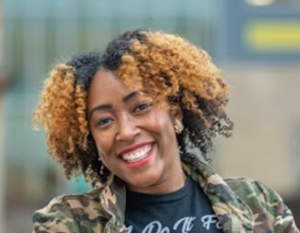
EatWell Exchange is a Durham-based nonprofit designed to “empower lower socioeconomic communities with the access, knowledge and confidence they need to eat a nutritious diet within their own food culture.” Aging Well Durham spoke with Jasmine Westbrooks, a registered dietitian at a Diabetes Outpatient Facility about EatWell Exchange’s (EWE) efforts in supporting more people of color to work in nutrition and to help folks eat healthier food from their cultural traditions, using the food of their cultures: personal, traditional, religious, or national. The Durham Aging Plan’s vision is that Durham has “a regionally appropriate food system actively addressing the unique circumstances and challenges that older adults face in meeting their nutritional needs.” Jasmine is one of three women with EWE.
How did you find yourself in this career? You had a family inspiration, is that right?
I grew up originally from Memphis, Tennessee. I’m a product of that type of environment:
- Being in an underserved community,
- Having grandparents who always made a way,
- Not really understanding that there was limited food access even when there were grocery stores around.
It wasn’t the most pleasant produce. You know, it wasn’t like your Trader Joe’s or your Whole Foods.
My grandparents died from medical conditions or chronic conditions like diabetes, heart disease, stroke, that could have been prevented. That’s where there’s a personal connection with me because they were very much from areas in the South that honored cultural foods. But when they would go to the doctor, the doctor or the healthcare system did not honor cultural foods and look for a healthy alternative to prevent chronic conditions.
I will definitely say that it’s personal because I’ve had family members dying. My dad has medical conditions that can still be avoided. But because of how he was raised, it has caused this disconnect to his health. Even still going through it now with family members, gives me that personal connection to it.
Right. Many older people have high blood pressure for instance. How do you straddle that line of meeting someone’s cultural needs while also serving nutritious food?
Honestly, when I went to school for nutrition, cultural foods were rarely a topic. It was a “telling people what to eat” business. It was very generic. Things like only identifying certain foods as being healthy, but not really being able to look at foods from different cultures that may be similar and that are also healthy.
What we’ve been able to do is just highlight different food groups and highlight different cultural foods that actually are associated with those food groups and let them know. Like, “Hey, yes, you’re being told to eat spinach, but did you know that callaloo, which is a Caribbean green, or that collards, which is a southern green, are all beneficial too?” It doesn’t necessarily have to be spinach, but it could be foods that we would think that, “Oh, that’s the bottom of the barrel” when it’s really not.
Callaloo! I have never heard of that. That’s fantastic.
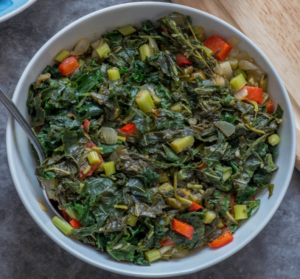
Yes, it’s so good. So that leads me to wonder, “How do you talk about cooking that particular vegetable?” In the South there are different ways of cooking things than in the North. I feel like for every culture, especially the Black community, no matter if you’re Caribbean, African American, African descent, period, you want your food to taste good. We break those myths around “Oh, healthy food has to taste nasty, for it to be healthy.”
That’s why we hold cooking classes. Because not only does it give the opportunity for people to try different recipes with a main ingredient being a cultural food, but it allows people to really kind of experiment – to try spices and herbs, to try different ways to get the flavor, without spending their own money. Being able to fund community cooking classes you can show, “Oh, did you know, you can use paprika with this? Or did you know, you can use lemon to bring out the flavor of whatever you added it to?”
Because a lot of times, to be honest, communities don’t want to spend money on things that they don’t know the taste of. If they don’t like it, then it’s a waste of money. I think that’s definitely one of our most popular ways to connect with the community – by doing cooking demos, community cooking classes, and programs. I’ll add that our cooking classes and cooking demos are not just step one, step two recipes, we’re actually giving education about each ingredient that we’re adding that we’re using in the class.
It becomes very engaging and it’s not just, ”Look at me cook or we’re just going to cook.” We’re all creating a community aspect of cooking cultural foods together.
You’re specifically interested in what you call lower socioeconomic communities. Can you tell us about what intersections keep socioeconomic communities nutritionally underserved?
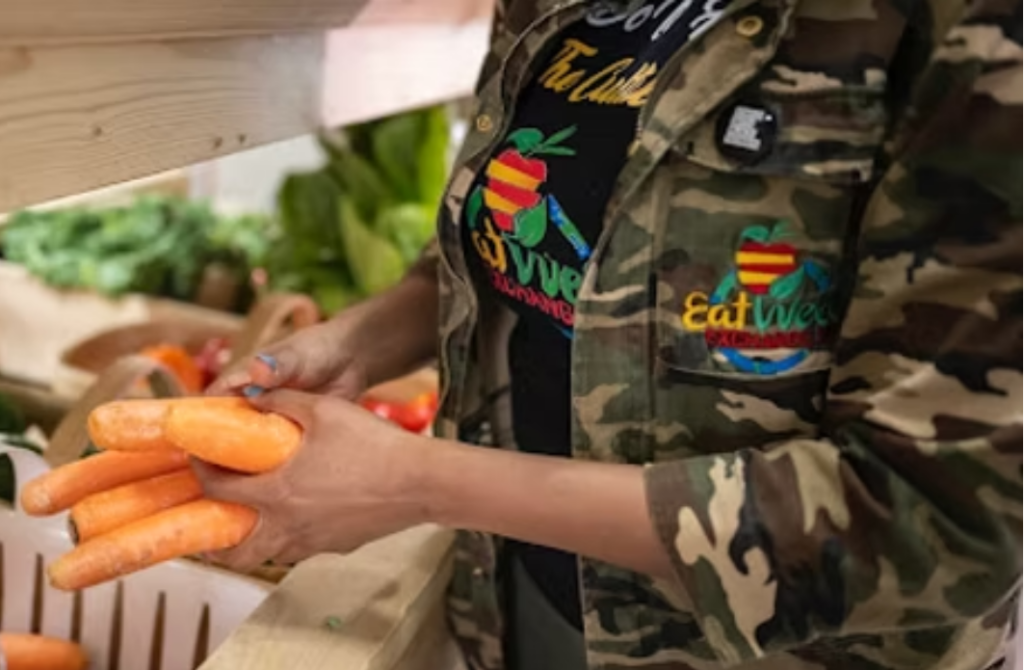
I think it really directly goes with the social determinants of it all. Often people think of social determinants and think only of a lack of a grocery store. But it’s really more than that. It’s about nutrition and education. How there’s so much of a lack of proper education around nutrition, even from certain healthcare facilities. Sometimes healthcare professionals are stretched so thin, it’s hard to engage a person in nutrition education.
When we think about access, I don’t just look at food access. I also look at access to Black dietitians. I’m a Black dietician, but we only make up 3% of all dietitians in the US! So to expect us to serve every black person in the US? I actually did the numbers. That would mean for every one black dietician, there would be 115,000 people needing service. That is not possible.
So what we’re doing is not only just, “Okay, we’re going to give you healthy food. We’re going to teach you how to cook it.” But we’re also working behind the scenes too, to educate other healthcare professionals about how they can provide culture-focused nutrition, because we can’t do it alone.
It’s going to take a lot of work to see the numbers go beyond 3%. But at least we’re trying to figure out what are some urgent things that we can work on while the other things that are more long-term are also in the works as well.
So you are mindful of sustainability, like teaching people how to fish, so to speak.
That’s one of the things that we’re implementing in our programs. This year has been the first year where I’ve actually not taught a lot of my classes or programs. I’ve hired people that look like me, that have the same passion, they get the mission, they want to learn, and they do it. Then their goal is to figure out what community members in the class that they can train to be able to go out and do the same.
It’s more of a legacy thing. I know that I can’t keep going like I’m going for the next 30 years or so, right? Because I’m in my 30s now, at some point, I do want to retire. You have to constantly plant these little seeds of legacy that can help keep the organization going because that’s the long term benefit.
How do you emphasize culture in food? You talked about that earlier, but maybe you could speak on it a little more, like a specific culture.
Absolutely, I think it’s important. This is something we tell health care professionals, too, and it’s number one:
- Don’t assume! Don’t assume that just because someone’s Black, they eat Soul Food, right? It’s really about getting to know that community and seeing what their favorite foods are.
- What foods bring you joy? If you don’t know that food item because it’s more of a cultural food that you’re not associated or familiar with, become intrigued and learn about it.
- Educate others on what the benefits are for that particular food that they may name as one of their favorites.
So that’s one way that you can connect with people without being out there like, “Oh, you must be Mexican. You must eat Mexican food?” That is not the proper way to do it. You’re actually stereotyping people now and that’s more offensive. Also building that trust too because not everyone’s going to tell you what their cultural foods are.
There’s a reason behind that. Like, for me, I’ve noticed in the Caribbean they’ve always used oxtails. But as soon as oxtails became popular on social media, it’s like, “Oh my gosh, everybody wants to get oxtails.” Then what happens? The people that are distributing the oxtails raise their prices. So now the people that were culturally eating those foods can’t afford them because now the mainstream kind of gets a hold of it and looks at it as being popular.
Oh, we gentrify food!
The same as avocados. Nobody was thinking about avocados until somebody gentrified it and it’s now in every person’s household. It’s not to say that’s not good, but why are we leaving the community behind?
It’s a business. It’s such a business mindset. How can we actually care about people?
I love “become intrigued.” That should be on a t-shirt. So, what are some of the perceptions about food that need to be changed?
Number one, definitely what we’ve been talking about, right? That there’s healthy food in every region, and it’s important for us as healthcare professionals, us as community members and leaders to recognize it and celebrate it. I would say that’s one.
Number two, there’s a big perception around foods with different types of carbs. I know for me as a dietician, I feel like carbs have gotten such a bad rep, but when you look at a lot of foods from different cultures, a lot of them are carb-based. It’s the base, whether it’s rice and beans or rice and peas, whether it’s grits, whatever it is.
I think there needs to be a change in perception around that because oftentimes what happens is we become the food police. And we say, because this person had cornbread, that whole meal is now unhealthy and that’s not true.
It sounds like you really meet people where they’re at.
Absolutely. Yeah. Absolutely. And I like to debunk a lot of myths. Not only just from talking with them, but actually like cooking with them and getting them to try, and being like, “See, I told you. You thought that we had to use a ton of salt when we just used the salt at the end to bring out the flavor instead of throughout the entire dish? ”That helps with your blood pressure, that helps with your blood sugars. It is definitely a “start where you are” type of mentality.
People taste the food at the end and they’re transformed. Even down to some other things we talk about, like social context. What we eat is not only influenced by availability, but also influenced by people around us. If you understand the social context, for instance in the African American community, most of us don’t want to be skinny. But if you look at the BMI and your doctor’s pushing that you need to be skinny, you’re going to have conflicting pressures, right?
So again, when we say cultural foods, it’s also about cultural traditions and experiences and what has been going on in the family. Like that story that we’re just big-boned, right? With all these misconceptions around size and all of that.
How can people support you?
There’s so many different ways. You know, with any nonprofit, there’s always room to partner when it comes to applying for grants or applying for funding together. I feel like we see a bigger return on what we’re trying to do when we actually apply for funding with people than just separately to fix the issue.
And if I’m honest, if people are going through things right now and they want to support but can’t do it financially, they can support by spreading the word about us. If you have a church or you’re a part of an organization, have us come in and speak and do a cooking demo or have us come and speak and host a cooking class or nutrition workshop.
If you’re having a vending event, we’ll come out and vend to tell other people because you’re exposing us to your community. We’ll tell other people about EatWell Exchange. We always take donations.
We do have a senior cooking program too. And we’re always looking to partner with organizations. It’s a total of six classes in a series.
Before we go, could you tell us about how the senior program is different. How do you approach nutrition and older adults?
Absolutely. So what we found, one thing that sticks out to me is that we’re having more conversations about food. I’m also a diabetes educator. In order to get that certification, I had to go through and talk about how clients’ diabetes medications impacted what they’re eating, their blood sugar, etc.
What we found is that a lot of times the older generation has no idea what the doctor’s talking about. Even when it comes to blood pressure medication. They say, “Oh, I can’t eat that.” No, you have to eat the same amount consistently for blood pressure medication. And they don’t really understand it.
That just shows you, they’ve trusted us so much when we do the programs that now the conversations start to go into other concerns that they have. Of course, we stay within our scope, but I feel that what sets us apart is that they’re open to discussing. ”I’m having this issue, Jasmine. What is it?” “I can’t eat greens.” We can be cooking greens and someone will say, “I can’t eat greens, it’s bad for my blood pressure medication” My response, “What blood pressure medication? Actually, you can. And let’s talk about how you can.”
Jasmine Westbrooks, M.S. RD | LDN, CDCES, works as a Registered Dietitian at a Diabetes Outpatient Facility and believes in a realistic approach to improving nutritional habits for better quality of life. Her interest in nutrition blossomed from health problems dominating her family’s life but could have been corrected through preventive diet measures. She earned her Bachelors of Science degree in Nutrition Dietetics from the University of Tennessee at Chattanooga and earned her Master’s Degree in Clinical Nutrition from Rosalind Franklin University.
She has worked as a Nutrition Educator in the Florida Department of Health for 3 years while counseling patients concerning health issues impacting the community. Throughout her experience and service with the community and with the Florida Health Department, she saw there was a huge need for nutrition education in minorities through culture.
Eating Well Exchange’s co-director is Ashley Carter RD | LDN