In this interview, Aging Well Durham (AWD) highlights the Adult Safety and Protection domain, an important part of the 2025-2030 Durham Comprehensive Aging Plan. April is Sexual Assault Awareness Month. The Plan includes this domain because of the vulnerability of older adults to abuse.
AWD spoke with Viola Lipscomb, Victim Advocate with the Durham Police Department – Victim Services Unit, about her experience with older adults, and helping people make their own decisions.
Can you tell me what department you’re in and what you do?
I am one of five victim advocates at the Durham Police Department. I’m what we call a law enforcement based victim advocate. We work with anybody who’s been victimized within the City of Durham. We deal with cases involving robberies, simple assault, aggravated assaults, homicide cases, as well as some sexual assault as well.
That’s quite a bit. You’re with the Department of the Police. You’re under their umbrella, but you’re not a police officer.
That is accurate. No badge, no gun. I work for the department to service people who’ve been victimized by crime.
Can you tell me about your work, regarding older adults and people with disabilities? Is there any crime trend, in Durham, for instance?
Crime is one of those occurrences of opportunity. You have got to have a person who’s interested in committing an offense, the opportunity to commit offense, and then somebody on the unfortunate end of that. I can’t say there’s any specific trends as it relates to older adults, people with disabilities and or sexual assault for that matter, because that would mean that the offender is specifically targeting that, and that’s not something you you can tell upfront.
Thank you for that observation, that we can’t necessarily observe disability, or age for that matter!
Older adults do tend to get targeted because of their age, their vulnerability. They’re less physically likely to be able to defend themselves and things like that. But I haven’t noticed a trend in that population being specifically targeted.

Well, that’s good. That’s great. As you said, older people can be more vulnerable to scammers, to violent crime, so we’re glad that we have people like you that can help survivors and victims.
Thank you. We do see a lot of fraud in scams, but that’s not specific to Durham. That’s on a national and international level. I created a personal database for myself so that I can track and see if there’s any specific trends. I can say just as much as older adults are being victimized, younger people than you and I are also being victimized. It really is a crime of opportunity. Whoever they can get, they’re going to get, and they don’t care what you look like.
Right, right, particularly in this age of AI. It has the potential to get worse.
Yes, I’m afraid it does.
Are there different cultural needs that you serve, or do you see any sort of trends regarding marginalized populations?
I have not noticed any trends in older adults being targeted. I haven’t noticed any trends in the LGBTQ community. I’m one of five advocates, so I cover one of five districts. My district, District Four, is one of the larger ones so it has a lot more activity. I can’t say that I have noticed any of our citizens or residents being targeted specifically because of who they are, what they’re affiliated with, whether it be religion, whether it be their sexual orientation, their identity, whether it be their age or anything like race. I can’t say that.
I know statistically, LGBTQ people tend to be victims of violence in larger numbers than, say, cisgender, straight people, nationally. But that may not be true for Durham, and I’m glad to hear it.
When you talk about targeted violence, I have not seen that. Then you get into domestic violence, that’s any intimate partner. Relationship issues, whether it be female-female, male- male or heterosexual folks, it doesn’t matter. If you’ve got issues in that relationship there is always has the propensity to involve violence. But again, that is not specific to lifestyle.
I think there’s probably a silence around exploitation and assault, and I’m just guessing, but I’m imagining that with older people, there may be a fear or inability to speak with someone about whatever might be going on.
Absolutely. I don’t know if you’ve ever seen that iceberg slide on an adult protective presentation. But they say for every one case that is reported as abuse, there are 24 other cases that are not reported. It’s not that people aren’t being abused. It’s just that when it comes to our older adult population, they are less likely to report it for a number of reasons.
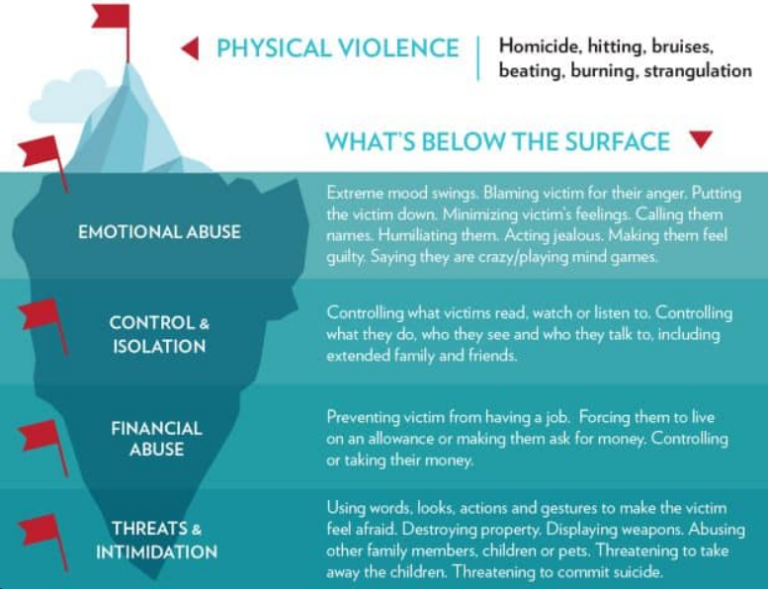
They don’t want to be seen as incapable of their autonomy. If I admit that someone took advantage of me financially, if I admit that my caretaker is taking advantage of me or abusing me, does that mean I now have to go into a nursing home? Does that now mean that I can’t age in place? There’s that component of it. There’s also the data saying that most people are abused by people that they know, love and trust.
If I’m 89, 93 and I have to admit that my son has been hitting me out of frustration because they have to care for me, that’s hard to say. If I have to admit that my granddaughter has been taking my car and taking my money and threatening to put me in a nursing home, that’s hard to admit.
When you rely on your caregiver for certain services and support so that you can stay in your home, and then they are the ones who are exploiting you, abusing you, or neglecting you – you’re not really going to speak up about that. Another caveat is that not everybody recognizes what they’re going through as abuse.
Yes, that’s so true. Can you say more about that please?
They might see, might not label it as that, because there might be generational beliefs about privacy. You just don’t talk about what you’re going through – shame and embarrassment. You might feel guilty: “Who did I raise? This is the person I raised. Did I really raise this kind of individual? Did I bring them up to treat people like this?” All those things start ruminating in their mind, and then add the fear of retaliation. Can they defend themselves? “If I do speak up, who’s going to be there to protect me?” Service and support has to meet certain criteria and that makes people fearful. It becomes, “ I’d rather just deal with it or stay quiet about it than to report it and suffer the repercussions.”
You brought up a lot of really great topics there. That is all just so true. To pivot a little, if I come to you as a survivor or a victim, what can I expect?
First of all, you can expect to be heard. Expect to be seen. You can expect support advocacy. You could expect compassion, and then we could get down to the nitty gritty: How can we help you? Because ultimately, we want to be victim centered in our approach. I can think of 100 ways that I can help you, but if you’re not there yet, if you’re not quite ready to receive it, quite ready to speak about it, I just give you enough information so that you can have informed decision making. So you know what is available.
So I would present solutions based on what you present to me. If you tell me what your identifying needs are, what some of your fears are, what some of your expectations are, then I can identify different resources and supports and services to help meet your needs and the capacity that you desire them.
Oh, that’s great. Consent is really important.
Important because there’s a thing called “dignity of risk and a right to self determination.” As someone who has worked in the adult protection field for close to two decades, I learned what that looks like. Now, being in this capacity as a law enforcement based victim advocate, I know that adults have rights, and they have the right to make poor decisions. They have a right to make no decision, and they deserve to be supported, no matter what decision they make. That’s how you gain trust, that’s how you gain respect, and that’s how you gain someone’s willingness to work with you, because then they feel like you’re working with them, not telling them what to do.
That must be really important, because the client is already in some state of shock or trauma, and I imagine it would be hard to trust people. Is there anything that you can say regarding victimization?
I think the response would be different for different experiences.
That is probably true. That question is too broad. I’m just thinking about older people and people with disabilities, regarding neglect or exploitation.
Thank you for the specific, for narrowing it down, because that does help. People have the right to make poor decisions, no matter what society thinks. There is the right to self determination, the dignity of risk, as long as you understand the consequences of what you’re going through. We honor that, we trust that you are the expert in your life. Barring no cognitive impairments or disabilities, and you can make decisions and you understand the consequences of those decisions, then we just offer different resources.

Let’s say you’re being abused or victimized by someone who has been taking you to your doctor’s appointment. Then we want to explore transportation options for you. Is there a way to get you to and from the doctors without relying on your abuser to do so? Let’s say that person was meeting your activities and daily needs. They were providing your bathing, they were providing grooming, and your grocery shopping etc.
Can we find other alternatives? Can we tap into some community based organizations who put in personal care aides and people who assist the person in their home? We want to make sure that your ability to age in place is honored. We try to find resources that are going to replace what you were getting from the person who was mistreating you, abusing you or neglecting you, so that you no longer have to be subjected to that.
You’re not only providing emotional, psychological support, you’re a problem solver.
I certainly didn’t think about that aspect of it, but that’s so important. If they have a disability and they’re unable to make decisions for themselves in a healthy manner, then we might want to look at Adult Protective Services. They come in and do a more holistic approach, and start looking at who your social supports are. Is living home and in your community still the safest thing for you? There are instances where the person might not be able to adequately make decisions for themselves.
Is there any kind of action that we can take as a community or as individuals to help keep Durham safe?
Oh yes, there’s always action we can take. I think being a safe space is crucial. Being a safe place, in a safe space for people who may be going through things that we don’t know about – because not everybody is willing to speak up about what is happening to them. If we just keep an open mind, we are non judgmental, then people will feel safer taking that first step: admitting that there’s something going on.
A lot of people don’t do that because they fear being judged. They fear being criticized or scrutinized. So just being approachable, in essence, understanding what those signs look like, paying attention to somebody being Intentionally isolated. When I give presentations in the community, I always say: watch your neighbors.
- Is your neighbor usually bubbly and outgoing, and now when you see them, they barely want to speak or make eye contact?
- Do they have different company coming around than they used to?
- Are they losing weight at a rapid rate?
- Are they not checking their mail like they used to?
- Are they not keeping up with their hair the way they used to?
- Are you not even seeing them in the community room or out in the community like you used to?
A lot of times, there are signs that something is going on. We could continue to educate ourselves to be aware of those signs and notice them. Sometimes a gentle approach, “how are you? Okay, I’m here for you, you know,” opens the door. If not, you can always call Adult Protective Services and make an anonymous or confidential report. That removes you from the responsibility of feeling attached to it, while also placing power in your hands to do something, or for someone to act on behalf of a vulnerable adult.
I love that. I think when we imagine exploitation or abuse in our own lives, there’s a feeling of helplessness and overwhelm, because there’s so much out there now, particularly with AI, as we mentioned earlier.
And if there’s a criminal component and they don’t want to call law enforcement, anybody could call and make a report. If it’s imminent danger, 911, always. But if it’s something that’s just being observed, “I just saw my neighbor with a black eye, and there was yelling, and the possible perpetrator just left. I’m concerned that they were just assaulted.” You could call 911, for those things.
If the threat is not imminent, we have a non-emergency line that’s monitored 24 hours. They can call and get their concerns, and then we can have an officer respond, and if they determine a crime has been committed, that’s how we get involved from the criminal aspect.
That’s good advice. Do you have anything you’d like to leave us with?
I think awareness on behalf of the community agencies is really important. Like I said, banks pay attention to people’s financial transactions all the time, so they notice when a person who normally withdraws $100 a week comes in and starts withdrawing $1,000 every two days. Just paying attention to people’s habits, unexplained injuries, if they start becoming withdrawn or fearful, and just seem different about themselves, someone who’s usually nice and well kept and well dressed.
If I start noticing some hygiene decline, things like that, I can start speaking up and being aware and being understanding. Collaboration between systems is essential. Talking to one another, keeping that open dialog, having those Multidisciplinary Team meetings with the multiple agencies at the table, and speaking about new trends and what some of the concerns are, and new developments.
I think collaboration amongst victim advocates, healthcare providers, senior experts like yourself, Adult Protective Services, is going to be ideal in serving our community, because the goal is really safety, dignity and autonomy.
Yes!
We don’t want to just stop abuse. We really want to restore people’s faith in service providers, because a lot of times, people will reach out for help, and they don’t always get it in the manner that maybe they hope for. That’s why I said meeting them where they’re at. Most older adults want to remain independent. We shouldn’t threaten them at the sign of something going wrong. We should really support them and their desire to age in place and remain in their homes and communities, because that’s where they thrive.
Being removed from that environment is not going to be good for them, psychologically or emotionally.
People don’t always understand domestic violence, for instance. In particular, that statistically it takes up to ten times for a victim to leave their abuser. It takes time, it takes time for a person to be ready to get out of that situation. So I imagine you have to be very patient.
You do, you really do. And trust that they’re going through their own process and the way that feels right to them. Because we could easily say, “Well, you know, you need to leave.” But maybe leaving is not feasible financially or for safety reasons or for logistical reasons. “Maybe my abuser takes the kids to school. My abuser pays the bills. If they’re not here, now we’re homeless.” That opens up a whole new realm of responsibility and fears. We just have to respect that and support them and meet them where they are, be victim centered.
Viola Lipscomb works as a Victim Advocate with the Durham Police Department – Victim Services Unit. She comes with close to two decades of experience working with older adults who have experienced abuse, neglect and/or exploitation. As a victim advocate her expertise with working with older adults, she acknowledges that the abuse in later life is best served through a community approach that offers safety, dignity and autonomy to those impacted. Viola holds a master’s degree in criminal justice and has been certified as a Victim Service Practitioner (VSP) by the North Carolina VSP Certification Academy.