Thank you so much. I really appreciate you taking the time to do this for us today. I went to the forum last year and it blew my mind. It was so informative and it really shifted some of the ways that I had been thinking about dementia.
Carmelita: Good to hear.
So jumping right in, can you tell us a little bit about your background?
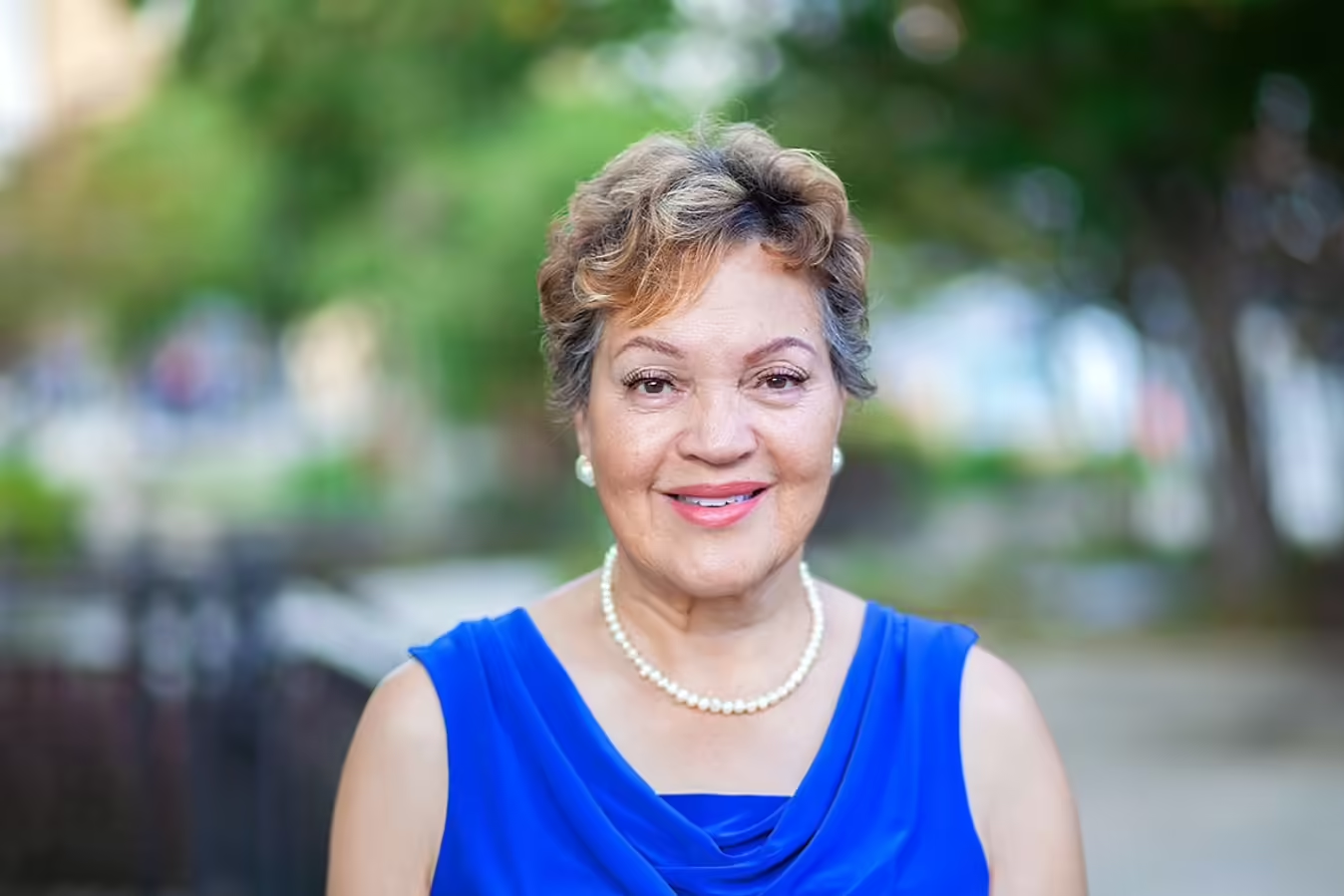
I’m older and things have shifted. But the experience in my youth, I would say, carried on to my older years and up to this point.
And there, specifically, two quotes that I’ve always kept close to my mind. The first one is a Latin term. “Caritas Christi urget nos,” which translates to, “the love of Christ urges us.’’
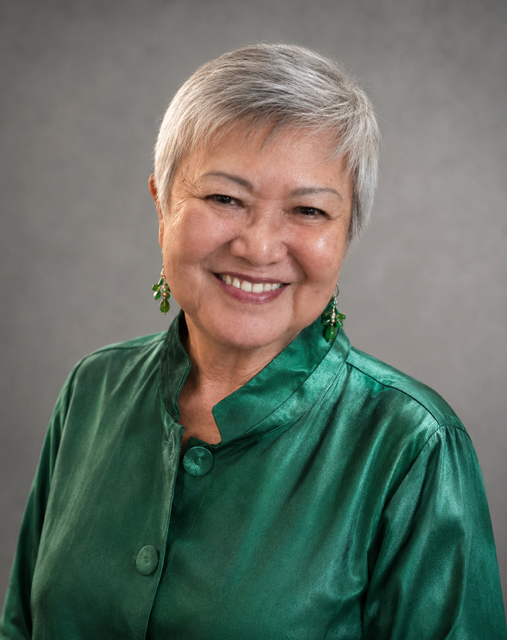
I was raised in a very very Catholic community and family and school. And so that was probably guiding all of my extracurricular activities. Especially when I was in high school. I remember, for example, convening a group of my friends so that every weekend we would visit the slums outside the city.
Oh, wow.
I see how the kids are doing. How are families doing?
Where was this, Carmelita?
Oh, this was in the Philippines.
Wonderful.
I was raised in the Philippines. And of course, the fun part of my memory is being a Girl Scout. Starting as a brownie. Yes. And actually, all the way up to my freshman year in college, people were saying, ‘couldn’t you just step away from Girl Scouting?’ But it gave me enough opportunity to be in the community and do whatever helps. Whatever the community needs.
And then I went. The whole experience of taking care of human beings in a hospital really confirmed my belief that we can help out, if we only put our minds to it.
Then the second term is “Service above self.” Have you heard about that? That’s the motto for the Rotary Club, Rotary International. I had the privilege of serving as a Rotary Club president. That is where I experienced the full extent of what service above self is all about.
It’s pretty self-explanatory, but…it’s a matter of being open to that opportunity to help another human being. So that’s my extracurricular activity. My professional career has been mostly in healthcare administration and aging. But the guideline that I always used was focusing on improving the quality of life of older adults and their families.
So throughout my work, I started seeing dementia and how it affects not only individuals living with the diagnosis, but also their care partners, their families, the organizations surrounding them and the communities where they live.
What drew me specifically and significantly to dementia, was recognizing that many challenges people face are not solely by the condition itself. Often they stem from stigma. It’s understanding an environment that is not decided, environments that are not designed to support cognitive changes.
That always makes me think about the environment. Is there enough signage? Is there enough light so somebody with a cognitive challenge can navigate the environment? That’s an example.
So I became passionate about helping and providing support. So that people with dementia can continue to participate, contribute, and continue life with dignity. That ultimately led me to co-found Dementia Inclusive Inc.
Amazing. You know, before you even elaborated, I thought “this is a person who is motivated by service.” That is a really, I think, a very powerful calling. It demands a certain amount of selflessness that we don’t find that often these days, I feel. There’s probably more of it than I know (I hope).
Would you please tell us about Dementia Inclusive, Inc.?
Dementia Inclusive Inc., or DII for short, is a not-for-profit charitable organization. It was founded in 2021. It is dedicated to enhancing the quality of life and well-being of persons living with dementia. I’m not sure if you’re aware that before Dementia Inclusive Inc., there was a dementia-inclusive forum. It was organized in 2015 by a group of us and the community, friends and colleagues where I started recognizing the need to do something. But it was purely volunteer-based.
We did not have any financial support, until we realized that there’s more that we can do. Hence, the need to organize and have the opportunity to be supported financially so we can move forward with the work that we need to do or that we recognize as necessary. Hence, the corporation was established in 2021.
Specifically, our mission is to build a culture of well-being. That’s the bottom line. Inclusion, health equity, and hope, for persons at risk of or living with dementia, and their care partners in our communities.
I was going to ask you to elaborate on that, what dementia-inclusive means.

Maybe if I kind of introduce what we are envisioning. That might help.
It’s rather an audacious vision, just as we thought it was when we were first thinking about it. We were envisioning an inclusive, resilient, and sustainable community where all persons facing life with dementia and their care partners are recognized and valued as individuals.
Just like us, just like anybody else, we envision that they are supported in their pursuit of this quality of life and well-being. Our work focuses on education and training, consultations, hence our annual community forum. Consultation (and) community engagements.
I think our aim is to help the community understand dementia. That’s reducing the stigma. Improving communication and creating environments that support inclusion rather than exclusion. I think. They created values and guiding principles. I think what stood out is remembering that a diagnosis of dementia doesn’t erase a person’s identity. That person is still there.
And they continue to have strength, preferences, and purpose. At its core. Dementia Inclusive is about recognizing that people living with dementia remain valued members of our community. And deserve opportunities to participate. Meaningfully. In everyday life. Just like you and me.
In Durham in particular, what might inclusivity look like or what does it look like?
A Dementia Inclusive Community is one in which people living with dementia feel welcome, respected, understood, and supported, wherever they are in their journey, let it be in the beginning, in the middle, or at the end.
It means they can continue to engage in community life. They can access services and maintain social connections without fear of stigma, judgment, and exclusion. I see a community where everyone: first responders, healthcare providers, faith communities, businesses, arts and cultural organizations, our libraries, our parks, our neighborhoods, civic organizations, students, our local government, and others, understand how to support individuals experiencing cognitive changes.
So it’s that issue of understanding what it is. The Forum will explore that understanding and then share the opportunities to act on that understanding. And what can we, as that group of sectors that I just mentioned, do together for the person with dementia.
I also see people living with dementia having a voice in decisions that are affecting them.
How can organizations, how can we build our capacity to be more inclusive?
Education. Like they say, knowledge is power. Yes. But I would like to add, knowledge is not power. Applied knowledge is power. You can know about it, but if you don’t do something about it, it doesn’t mean a whole lot.
That makes sense. I love that.
Yes. So going back into building capacity for organizations. I think the staff needs practical training on dementia awareness and especially on communication. Because there are unique needs of persons with cognitive decline. And organizations should also examine their policies.
There should be physical spaces, signage, their customer service practices, and programming–through the lens of accessibility and inclusion. Most importantly, they should listen directly to people living with dementia. To guide this improvement. I’ll share with you just for a few moments an experience early on that I keep in my mind, and the folks involved in this experience remind me about it with fondness, once in a while.
A few years back, I was invited by a faith community to meet with them, to talk about how they can make their environment dementia-friendly or dementia-inclusive. So we talked about the need for signage, and we talked about special challenges of persons with dementia and how this could be addressed.
I said, “How about if we go tour your building?” We walked out of the room and they stood around and they started to laugh. Oh my goodness. “We’re standing here and we don’t have any idea where anything is!”
I hear that story every once in a while when I meet the faith community folks. They said, “’It was so clear, but we did not know it. It was a matter of remembering or realizing the unique needs of somebody with cognitive decline.’’ So they actually renovated lighting, changed the color of the walls, put signs up that are more cognitive, so somebody walks in, they know exactly where the offices are, arrows to the ladies’ room,and you know, so on and so forth.
That’s one of my fond memories, and the folks still remind me about it.
Carmelita, what would you like people to know about dementia? What misconceptions do people have?
One of the things that still amazes me, to this day, people are still confused and use Alzheimer’s and dementia as one and the same. But they’re not. Dementia. It’s not a disease. Rather, it’s an umbrella term for different illnesses or diseases that cause problems with thinking, memory, and especially the ability to function well in daily life.
Alzheimer’s is the disease which is the most common form of dementia.
I see.
But there are other dementias, and those are the most recognized: vascular dementia, Lewy Body Dementia, Temporal Dementia.
So you can imagine this umbrella term. You have this dementia umbrella, and then under that are the different diseases. Alzheimer’s – there’s about 60 to 70% of all dementias worldwide. It’s the most common form.
One of the most important things that I would hope for is for people to understand that a diagnosis of dementia does not mean the end of a meaningful life. People living with dementia can continue to experience what you and I are experiencing. Some joy, purpose, relationships, creativity, and personal growth. But that’s where putting knowledge into action applies.
The community plays such a key role in making sure that life is lived meaningfully. A common misconception is that people with dementia are commonly unaware of what is happening around them. In reality, many individuals are aware of their surroundings and emotions, particularly in the early and middle stages of their condition.
Another misconception is that dementia is a normal part of aging. Age is a risk factor and one of the key risk factors. Dementia is not an inevitable consequence of growing older. Rather, it is a collection of diseases that affect brain function. Perhaps the most harmful misconception is that people living with dementia have nothing left to contribute. But people with dementia continue to have strengths, preferences, wisdoms, and experiences that can enrich our community if we only provide that opportunity.
To me, if people remember only one thing, let it be that dementia is not just a medical issue. Which a lot of people are considering. It’s a community issue. People living with dementia can continue to live meaningful lives when communities choose inclusion, understanding, and support.
I was going to ask you about community. Our work at Aging Well Durham stresses the importance of age-friendly community, and I imagine it plays a huge role in relationships, with caregiving.
The point is that community is so essential. Because no individual or family should have to navigate dementia alone.
My vision extends beyond healthcare settings. Families should be able to find understanding and experience in their neighborhoods. In their place, in the businesses that they visit, in their community centers, in their library. Care partners should have access to education. Respite.
Yes!
Opportunities for being able to step back, for their own well-being, to help – support groups and resources that help them maintain their own well-being – and I’m talking about the care partners now. I see a dementia-inclusive Durham that would recognize that people living with dementia really benefit everyone. I truly believe communities become more compassionate and connected when they intentionally include those who are most vulnerable.
And I think a dementia-inclusive Durham is not simply a better place for people living with dementia. It’s a better place for all of us. I think the measure of a community is how well it includes and supports its most vulnerable members. And I really believe Durham must get an opportunity to lead by example, don’t you think?
Absolutely. We are well positioned to be leaders in this arena and others as well, I feel. We’re forward-thinking. We understand the need for community. Those are inherent in the city’s values. So it’s just a matter of waking everybody up on that knowledge. Education is essential.
Speaking of which…Are there any modalities or new medications that we can look forward to that you’re aware of?
I’m not going to talk about specific medicines. I’ll talk about it in generalities because there’s so many that are coming in on the market fast and furious and it’s something that I try to really back away from.
However, we are living through an encouraging period of progress in dementia research. Phenomenal, phenomenal accomplishments. There are several newer therapies aimed at slowing aspects of Alzheimer’s disease. This has generated significant attention lately and researchers continue to explore.
However, it is important to remember that the medical approach is only one piece of the puzzle. I think equally important are non-pharmacological approaches, such as physical activity, social engagement, cognitive stimulation, and a healthy lifestyle, education, modifying the environment, and person-centered approaches.
So these are the things that are still out there that we need to offer in education and training. So hopefully, over the months and the years, we can slowly carve that opportunity. I believe that there is much more reason for hope today than there was even 10 years ago.
We’re learning more about prevention.
Right. Of course, the future of dementia will likely involve the combination of medical advances, early diagnosis, and preventive strategies.
Most importantly, we needed a stronger community support system. I think that should be one of the aims that all of us should strive for.
Thank you for that. It seems to me that almost every other day I see a new article on dementia, and often it is about lifestyle change.
Yes, which is wonderful. So we are going to offer that as one of the topics for presentation at the forum. I know we did it last year, but we offered it in the view of research. But this one we’re going to offer the information in a practical way, how it could be applied and considered.
I look forward to that.
Is this your last forum or are you going to continue to work with the forum?
Oh, I hope, if they allow me to. I would love to continue. I couldn’t tell you how grateful I am for the opportunities I’ve had throughout my career. For the amazing people I’ve met along the way, including you. I’m stepping down in my role as Executive Director for DII. That could be viewed as marking the end of one chapter. For me, that’s only a chapter that I’m kind of stepping down for.
It doesn’t mean slowing down completely.
I can’t imagine it would, Carmelita. It just seems to be from the heart rather than “this is my job.”
Yes. Thank you. So you may already have picked up that dementia inclusion remains deeply important to me. And I hope to continue advocating and helping so Durham can become the place where everyone belongs.